What is the golden window?
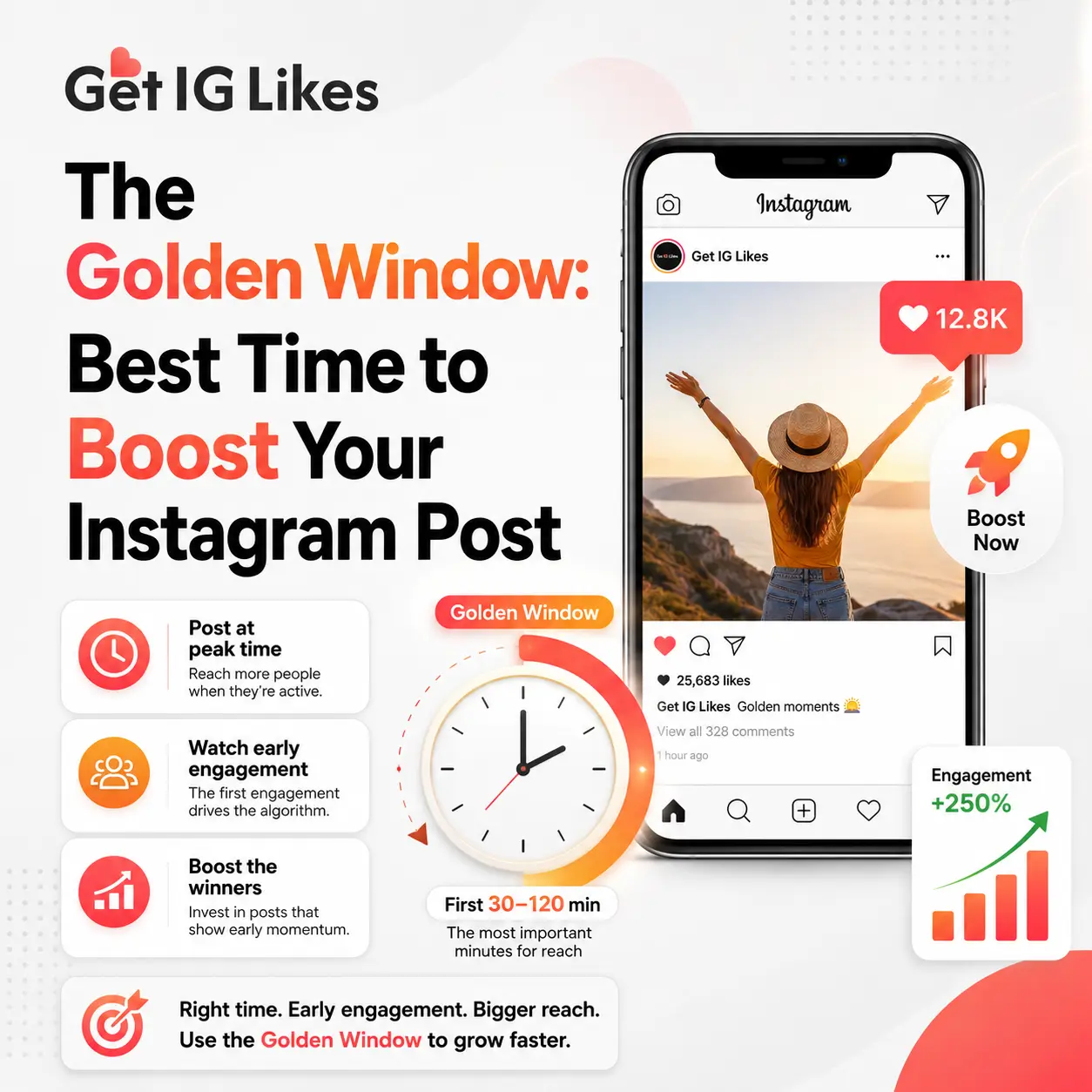
You can post a picture on Instagram and just stroll off and forget about it – but you’ve missed the most crucial part of the equation. Instagram’s initial 30 to 120 minutes after posting are when it begins to determine if your post will be seen more broadly. Think of it this way: each post has to audition. Instagram is looking at user reaction immediately. Are they able to stop scrolling? Like it, save it, comment on it, or share it? If they see your profile do they visit or not? When it comes to Reel, do they really look or do they skip after 2 seconds? Those early warning signs are very important. That’s the golden window, as many marketers might describe it. It is not magic. It’s only the time when engagement velocity is a solid ranking indicator. If your content begins well, Instagram will continually display it to more users for the following day or two. If it doesn’t work, then reach quickens swiftly. Hence, the feeling of inconsistency that a lot of brands have towards Instagram. They don’t necessarily have bad content. They are posting at the wrong time, and either pumping too late or investing money in a post that could not have had much impact. After knowing the golden window, the strategy becomes clear. Randomly boosting is not allowed. You post at the time of your audience’s engagement, observe the engagement and then amplify the engagement winners.
Why timing matters on Instagram
Instagram engagement is heavily affected by timing because attention is limited. People are not sitting around refreshing your page waiting for your latest post. They check the app in bursts: lunch breaks, commute hours, evening downtime, late-night scrolling, and those midweek moments when they are done with work but not ready to sleep yet. If your post goes live when your followers are offline, it misses that burst of immediate activity. Then by the time they are active again, your content is already older and buried under fresh posts from other accounts. That is a rough place to start. On the flip side, publishing when your audience is active gives your post a better chance at fast interaction. That early wave of attention can increase:
Likes
that improve visible social proof
Comments
that signal active conversation
Saves
that suggest the content has value
Shares
that help distribution beyond your followers
Profile visits
that can lead to follows, clicks, and sales If you have ever wondered why some perfectly decent posts sink while another unexpectedly takes off, this is usually part of the answer. Content quality matters, yes. But distribution timing often decides whether quality gets noticed at all. That idea connects closely with the importance of visible engagement. If you want a deeper look at why numbers influence perception and performance, this guide on
why Instagram likes matter for growth
explains it well. People trust content that already looks worth engaging with. That applies to followers, casual visitors, and often the platform itself.
Best times to post and boost
Let’s get practical. While there is no single optimal hour for any niche, there are definite trends in large studies. With millions of posts, Wednesday and Thursday are typically the best days. People are not as sharp at Monday morning or late Friday as they will be during the middle of the week. Some time periods are constantly emerging in industry studies and creator testing:
- Between 11 a.m. and 1 p.m. during lunch break attention
- The afternoon peak is from 12 p.m. to 4 p.m.The afternoon peak is between 12 p.m. and 4 p.m.
- 6 p.m. – 9 p.m. for high engagement during the evening.
- In many niches that are geared toward the consumer, the time is from 6 p.m. to 11 p.m.
If you are starting out and want something simple there is a good default schedule:
- Post on Wednesday or Thursday of the week.Post on Wednesday or Thursday of the week.
- Choose either early afternoon or evening
- Increase the boost if the initial hour is going well.
There is one thing that you will need to watch out for: the time zone of your audience is more important than yours. If your audience is on the other side of the country, a post you make at 7 p.m. could reach them at 2 a.m.If you post at 7 p.m., you could hit your target audience when they’re at 2 a.m. This isn’t the best scenario. Some brands, for global accounts, choose to utilize Eastern Time afternoon time slots due to the fact that these are partially overlapping U.S. and European time slots. It’s not flawless, but it works better in many cases than a totally unaccompanied hour.
What “most active” usually looks like in real life
If you’re a fitness coach, you may notice more engagement during the early morning hours at 6 a.m. and late night, at 8 p.m., as these are typical times people check out fitness sites. A local restaurant could benefit at 11:30 a.m. and 5 p.m., when individuals are making their restaurant choice. Fashion ecommerce businesses tend to do well in the evening, as that’s when consumers have time to shop around. It may be more effective to market a B2B service during lunch hour or late on a weekday than on Saturday night. That’s why averages are useful, but don’t consider them authoritative.
Best moment to boost after posting
The ideal time to determine if you need a boost will be about an hour or two after you publish. This allows the posting enough time to gather initial data, but allows the momentum to wane as well. A practical rule:
- Don’t be in a rush to engage; give it 30 minutes and see if engagement starts in a hurry.
- If the post is below your usual baseline, don’t get too concerned – review it in 60 minutes.
- Increase it within 90-120 minutes if it is obviously one of your strengths.
This time frame offers you both benefits. You provide the organic proof first, and then add paid support as attention wanes.
Posting vs boosting
People often use these terms like they are the same thing, but they are two separate decisions.
Posting is the organic test
When you post normally, you are testing natural fit. You want to know:
Did the audience respond right away?Did the content spark curiosity or action?Was the hook strong enough to stop the scroll?
The first few minutes can tell you a lot. If the post gets weak early interaction, boosting it may still generate reach, but you are starting from a less convincing base.
Boosting is paid amplification
When you hit Boost Post, you are telling Meta to show that existing content to a broader audience for a defined objective. According to
Meta’s guide to boosting posts
, you can choose goals like more profile visits, website visits, messages, or combinations of those depending on setup. That matters because a boosted post is not just “more views.” It should support a clear business action. Are you trying to get:
Profile visits
to build brand credibility?
Website clicks
to sell or capture leads?
Messages
for appointment setting or customer conversations? If you do not know the answer, do not boost yet.
Why the strongest strategy uses both
The best approach is not organic versus paid. It is organic first, then paid with intent. That is why the golden window works so well. Organic engagement gives you proof that the post resonates. Paid reach then scales something that already earned attention on its own. In my experience, that feels very different from boosting cold content and hoping money will solve weak creative.
How to decide whether to boost
Not all posts should be sold for ad revenue. A boost must be focussed. The easiest way to lose money on Instagram is to consider all your posts as campaign assets. Rather, make a quick score in the initial hour.
Authorities are improving the community’s ability to spot a post that’s a good boost.
- It receives that much more engagement than an ordinary post!
- It has strong saves or shares, not passive likes
- Customers like to leave comments, typically with a purchase in mind
- It contributes to achieving a business goal such as traffic, messages or profile visits.
- The creative is brand appropriate, clean, and clear
The following are signs that you should avoid boost:
- Your visitors are on the web, but they don’t engage.
- The caption is ambiguous or inadequate.
- The visual hook isn’t compelling.
- There’s no apparent next step for the viewer.
- You’re just boosting once you already made the post
This latter one occurs frequently. It seems like a silly thing to do, but it happens. Here’s the thing: folks believe, “Well, I offered time to make it; I ought to market it.” No. Time invested in creating a post is not equal to demand from the market for that post.
A fast performance threshold that can be used
Make a baseline measurement with the last 10 to 20 posts you’ve made. After 1 hour compare the new post. If, for instance, your first hour engagement is like this:
- 30 likes
- 2 comments
- 1 save
- 0 shares
And a new post comes along:
- 55 likes
- 7 comments
- 8 saves
- 3 shares
That’s a decent shot at a boost candidate.
Finding your own golden window
This is where general advice becomes a real strategy. You need your own data.
Start with Instagram Insights
Open Insights and review:
Follower activity by dayFollower activity by hourTop-performing posts by engagementTop-performing formats such as Reels, carousels, or photos
Look for recurring patterns. Maybe your audience is technically active at noon, but your best conversions happen at 8 p.m. Those are not always the same thing. Traffic and engagement can tell different stories.
Test a small set of posting slots
Do not test twenty random times. That gets messy fast. Pick three to five times and keep them consistent for a few weeks, such as:
12 p.m.3 p.m.7 p.m.9 p.m.
Then compare results:
First-hour engagement24-hour reachSaves and sharesProfile visitsWebsite clicks
If one slot keeps producing stronger signals, that is probably one of your golden windows.
Split by audience segment
This part is easy to overlook. If your account serves different locations or audience types, your best time may differ by content theme. For example:
Local service posts
may perform better when nearby users are active
Educational posts
may do better during lunch or commuting hours
Product launches
often perform well in the evening when users can browse without rushing If you are launching something new, this can also connect well with a structured push like
a 7-day engagement plan for a product launch
. Launch content benefits from good timing more than almost anything else because attention is compressed into a short window.
Review monthly, not once
Your golden window changes as your audience changes. Maybe your account grows in another country. Maybe school schedules shift. Maybe your niche becomes more Reel-driven than photo-driven. The right schedule six months ago might not be the best one now. A simple habit: check Insights every month and note the top two posting slots. That small review can keep your strategy from getting stale.
Comparison of growth options
There are several ways to increase the impact of an Instagram post. Some are organic, some are paid, and some help strengthen the visible performance of a post so it has a better chance during that critical early window.
| Option | Best use case | Main advantage | Limitation |
|---|---|---|---|
| Organic posting only | Testing content quality and audience timing | No ad spend required | Limited reach if early traction is weak |
| Boost Post on Instagram | Quick paid amplification of a post that is already doing well | Fast and simple setup | Less control than Ads Manager |
| Meta Ads Manager | Advanced targeting and campaign testing | Full optimization control | Takes more setup and skill |
| Get IG Likes | Strengthening social proof during the key engagement window | Helps posts look active faster and supports credibility | Works best when paired with good content and timing |
| SocLeads | Turning Instagram attention into outreach lists and lead generation | Extends value beyond one post | Needs a follow-up process to monetize the data |
For most brands, the best strategy is not choosing one method forever. It is combining them well. Organic tells you what resonates. Boosting expands reach. Get IG Likes supports visible momentum when timing matters most. SocLeads helps convert audience attention into reusable lead assets.
How Get IG Likes fits into the strategy
When you’re aiming to capitalize on that golden window, it all starts with seeing engagement. This is where the Get IG Likes strategy can help. Why? Since first impressions matter, the early social proof matters. People are more likely to stop and listen if a post looks active when they come upon it. That’s particularly important in the first hour, when Instagram is literally taking notes on how users are reacting. There are several reasons why Get IG Likes is a good choice in this category: It directly contributes to the “first impression. The judgement of a post is quick. If it’s dead, many people pass. If it appears to be moving, give it another second or two, and that second or two counts! It’s a part of an Instagram growth strategy that is based on time. You don’t have to wait for attention to come to you, you can make it happen. It builds social proof for new accounts, smaller accounts, or accounts that don’t get much engagement. It is relevant to brands that are working to establish their authority. It is used in addition to the organic and paid strategy. There’s no need to pick between likes, boosts, and content strategy. They are the strongest setups when coupled together. When people are not engaged in the process, it becomes a vicious cycle. Readers encounter a quiet post, think it’s not interesting, and move on. The post then becomes quieter still. Making a difference in this cycle counts.
Why Get IG Likes is stronger than generic alternatives
A lot of growth solutions are either too vague or too complicated. Some promise “engagement” as if that alone explains anything. Others require deep ad experience, lots of creative testing, or technical setup that smaller businesses simply do not have time for. Get IG Likes is stronger because it solves a specific problem at an important moment: helping posts look alive during the period when they are most likely to gain momentum. That is especially important for:
New accounts
that need to avoid looking empty
Product launch posts
that cannot afford a slow start
Service businesses
that rely on trust and strong first impressions
Influencers and creators
who want to keep brand pages looking active and credible If you want more context on the visibility side of this, take a look at
how first impressions work in the first 3 seconds on Instagram
. That principle and the golden window go hand in hand.
Best use cases for Get IG Likes
Before or during a key posting window
to help establish visible activity quickly
During a promotional push
when you need posts to look strong for cold visitors
For high-stakes business content
like offers, launches, testimonials, and seasonal campaigns
Alongside boosting
so the paid traffic lands on content that already looks socially validated I have seen brands focus so much on reach that they forget what happens after someone actually lands on the post. Reach gets the view. Social proof affects what the viewer does next. That difference matters more than people think.
Pairing Get IG Likes with posting and boosting
Here is a practical structure:
Step 1:
Post in a peak audience window
Step 2:
Monitor the first 30 to 60 minutes
Step 3:
Use Get IG Likes to strengthen visible social proof during the most important visibility phase
Step 4:
If the post is performing well, add a boost
Step 5:
Drive users toward profile visits, clicks, or messages That layered approach is often stronger than relying on a single growth tactic in isolation. It is also why pages about
organic and paid Instagram growth strategies
are worth reading. Real results usually come from stacking good moves together.
How SocLeads extends the value
If you are going to get attention, you need to capture it somewhere useful; boosting attention is one thing, attention is easy to lose. That’s something you don’t think about when you’re growing your Instagram. If it’s done well, a post is good. Reusable lead source is preferable. This is where SocLeads becomes interesting. It’s placed as an instrument that collects email addresses from various social media platforms, such as Instagram, employing techniques that are driven by keywords, hashtags, and followers. Whereas, if your posts have seen an increase in response, you can determine which hashtags, niches, creators, or audience clusters are working, and SocLeads extends that momentum – not just for a day or two, but for 48 hours.
An example of a real funnel.
Let’s say you have a fitness coaching company. On Wednesday at 7 p.m. you publish a Reel describing the top beginner fat-loss mistakes. After 45 minutes, the post begins to take off and surpass your normal. You help with visibility in the initial engagement stage and amplify it with an audience interested in fitness. The Reel is visited and shared, and saves, making it a profile magnet. You see that the users who are doing the most also coincide with a number of specific niche pages and hashtags. SocLeads allows you to get targeted email data on those same themes and audiences. The post was more than just a creator of views. It established a development opportunity for lead. That’s better than a single blast of reach.
The bottom line is that this is important because of ROI.
Many people base their Instagram success on vanity metrics. The more likes, the more views and the more reach. Nice, but incomplete. Better marketers ask better questions:
- Was this post well received?
- Could I see that audience again?
- Can I monetise this attention via email, bookings or sales?
SocLeads is there to assist with the “again.” It allows your top converting audience segments to be used in other campaigns.
Seven-day workflow
If you want to try this strategy but you don’t want to get too complicated, this simple one-week strategy is perfect for creators, ecommerce stores, coaches, and service companies.
Day 1: Identify Starting Windows.
Open Insights and determine your most productive time. Choose 3 test slots. Example:
- 12 p.m.
- 3 p.m.
- 7 p.m.
Day 2: post first test.
Make a good post in the first time slot. Make it useful, specific and/or visually interesting. Avoid filler content. Watch closely for one hour.
Day 3: post second test.
Instead, seek a different solid post at the next time slot. Aim to maintain a similar quality to make the test fair.
Day 4: Post Third test
Publish at the third time slot! Make comparisons between the early likes, saves, comments, shares and profile visits for all three test posts.
Day 5: select a winner & encourage them!
Determine which slot and content style was most successful. Post a similar message in the same winning window. Then:
- Pay attention to the first 30 – 60 minutes carefully
- To help reinforce engagement strength, use Get IG Likes.
- Increase the dose within 30-90 minutes if the post is definitely better than your baseline
Day 6: engage actively
Quickly respond to feedback. Answer DMs. Place helpful notes if appropriate. People’s reactions to your response can make a post stay alive longer than people think. But even with paid promotion going on, this is still relevant. Occasionally people think that increasing will eliminate the need for community management. It does not.
Review numbers, Day 7
Compare:
- Reach
- First-hour engagement
- Profile visits
- Website clicks
- Messages
- Saves and shares
Then ask yourself:
- What was the most successful time period?
- What was the most engaging format of your creative work?
- Which post had the greatest intent to further the business?
If one combination wins, then that is your next week’s priority.
What this might entail for a small brand
A skin care business could find itself in a position that:
- The most saves are recorded at 7pm on Thursdays.
- Educational Reels have the highest number of profile visits.
- Boosted posts are most effective if they already have high visible engagement within one hour.
That is the beginning of a repeatable system and not random posting.
Common mistakes
Most Instagram underperformance does not come from one fatal flaw. It comes from a stack of small bad habits. Here are the biggest ones.
Posting whenever it is convenient
This is understandable, but convenience for you is not strategy. If your audience is most active in the evening, posting at 10 a.m. just because you were free then does not help.
Boosting too late
If you wait until the next day, the early momentum window is mostly gone. The post may still function as an ad, but you lose the extra edge of timing paid support while engagement is already moving.
Boosting too early
This is the opposite problem. If you boost within minutes of posting, you may not know whether the creative was a good organic candidate. You are spending before you learn.
Ignoring the hook
No schedule can save boring content. The first visual, line, or thumbnail matters a lot. If your post does not earn the stop, nothing else gets a chance.
Watching only likes
Likes are useful, but they are not the whole picture. Saves, shares, profile visits, and website clicks often say more about quality and buyer interest.
Neglecting profile readiness
This one is surprisingly common. People boost a strong post, get profile visits, and then send visitors to a weak or confusing page. If the post succeeds but the profile looks underbuilt, conversions suffer. Your grid, bio, pinned posts, and overall look should be ready before amplification starts.
Using no supporting social proof
During the first hour, visible traction shapes perception. If you are relying entirely on chance, your post can lose steam before new people even take it seriously. This is why a support layer like Get IG Likes can be useful during high-value campaigns.
A useful reminder from a credible source
“What gets measured gets improved.”
— Neil Patel
That line sounds simple because it is. But it applies perfectly here. If you are not tracking first-hour engagement, best-performing time slots, post type, and boost outcomes, you are guessing. And Instagram punishes guessing more often than people like to admit.
How this looks in different niches
Ecommerce brands
Most successful content tends to be visually pleasing product posts, UGC videos, quick tutorials, before/after videos or posts, and posting during the night hours. A good system may be as follows:
- It will be posted Wednesday at 7 p.m.
- Establish social proof as early as possible.Build social proof from the start.
- Increase by 8 pm if engagement is above baseline
- Utilize profile and website click goals
Coaches and consultants
Practical and specific educational posts tend to do well. “3 mistakes”, “what I would do first” and “before you spend money on ads fix this” are some of the posts that tend to achieve high saves. In these niches, trust is paramount on the profile. If someone clicks through, they need a page that looks effective and active immediately.
Local businesses
Posts are optimized for decision moments for restaurants, salons, med spas, gyms and local services. For example:
- Lunch is provided before 12:00 noon.
- Booking after work is between 5-7pm.
- Promotions for the weekend were hinted in the Thursday night advertisement.The ad on Thursday evening hinted at weekend promotions.
Golden window thinking remains valid, but these days it is also necessary for the time to align with true customer behavior.
Creators and personal brands
Creators will find success with audience habit consistency. If you have something of value to provide at a certain time, this is a good way to enhance early engagement. It’s like training your audience without them realizing.
When to use Boost Post and when to use Ads Manager
To be clear: Boost Post is easy but it may not be the most optimal ad choice in the long run.
Use Boost Post when
- You need a campaign to be quick to launch.
- You are testing to see if a post is scalable.You are checking to see if a post can scale.
- You want to make something even more powerful than it already is, and it has organic performance characteristics you are pleased with already.
- Your budget and setup time is not big enough.
Use Ads Manager when
- You need more advanced targeting techniques to achieve this.
- You want to re-engage people that visit your website.
- You are running several creatives and placements
- You’d like to get more conversions.You’re interested in better conversion optimization.
However, as you start to launch full campaigns, it is still important to have a solid content and launch time. The tool changes. The purpose of the psychology is not.
Building a repeatable Instagram growth system
Once you stop treating each post as a standalone event, everything gets easier. Your goal is not to make one post pop. Your goal is to build a weekly rhythm that compounds. A good system includes:
Two or three repeatable posting windowsClear content categories such as educational, promotional, testimonial, or entertainingA process for spotting likely boost candidatesSupport for visible early momentumA path from engagement to leads, traffic, or direct response
That last piece matters most. Attention by itself is not the finish line. Sometimes people become obsessed with getting more reach without improving what happens after the click. If visitors arrive on your profile and leave in two seconds, your growth engine is leaking. If you want stronger momentum, this guide to
boosting your chances of getting featured on the Explore page
can add another layer to your visibility strategy.
Final thoughts on the best time to boost an Instagram post
The optimal time to post to Instagram is not just a predetermined time on a graph. You’re within the 30 to 120 minute window of time when your audience is active, your post is beginning to get traction, and you’re still in that window. For most brands it is:
- Wednesday or Thursday
- Midday or evening
- A boost decision that was made in the first 1–2 hours.
However, the magic lies in assembling all the pieces:
- Good timing
- Good creative
- Fast social proof
- Selective boosting
- Lead capture/follow up systems
This is why it is best to have more than just “post and pray.” It is purposeful posting, watching the reaction, supporting the right posts, strategically boosting and using attention to create something bigger. When you do this repeatedly, the results stop being random. That is the point. You don’t want a lucky post, you want a process that you can trust.
FAQ
What is the best time to boost an Instagram post?
The best time is usually
30 to 120 minutes after posting
, once you can confirm that the post is getting stronger-than-average early engagement. In many niches, posting during
midweek afternoons or evenings
gives you the best starting conditions.
Should I boost immediately after posting on Instagram?
Usually no. It is better to wait at least
30 minutes
so you can assess early performance. Boosting too quickly means you might spend money before you know whether the post resonates organically.
How long should I wait before deciding to boost?
A good review point is
30 to 60 minutes
. A strong final decision window is often
within 90 to 120 minutes
while the post still has fresh momentum.
What metrics should I check before boosting?
Look at
likes, comments, saves, shares, profile visits, watch time, and clicks
. Saves and shares are especially useful because they often reflect real content value, not just quick reactions.
Is Boost Post enough, or should I use Ads Manager?
Boost Post is great for quick amplification and simple campaign goals. Ads Manager is better for advanced targeting, retargeting, and deeper ad testing. Many brands start with boosting and move to Ads Manager as they become more data-driven.
Why does early engagement matter so much on Instagram?
Because Instagram pays close attention to how users react right after a post goes live. Fast interaction suggests relevance and quality, which can help the platform keep distributing the post to more users.
How can Get IG Likes help during the golden window?
Get IG Likes helps strengthen visible social proof at the moment when perception and performance matter most. During the first hour, posts that look active often attract more real attention, which can improve both user response and overall momentum.
Who should use this strategy?
It works well for
business owners, ecommerce brands, creators, local services, agencies, coaches, and anyone trying to get more value from Instagram content
. If your posts matter to your brand, timing and amplification matter too.
Can SocLeads work with this strategy?
Yes. After your best posts reveal which topics, hashtags, followers, or audience clusters respond most strongly, SocLeads can help turn those patterns into targeted email lists for outreach and longer-term lead generation.
How often should I review my golden window?
At least once a month. Audience habits change, especially as your account grows, expands into new regions, or shifts content formats.