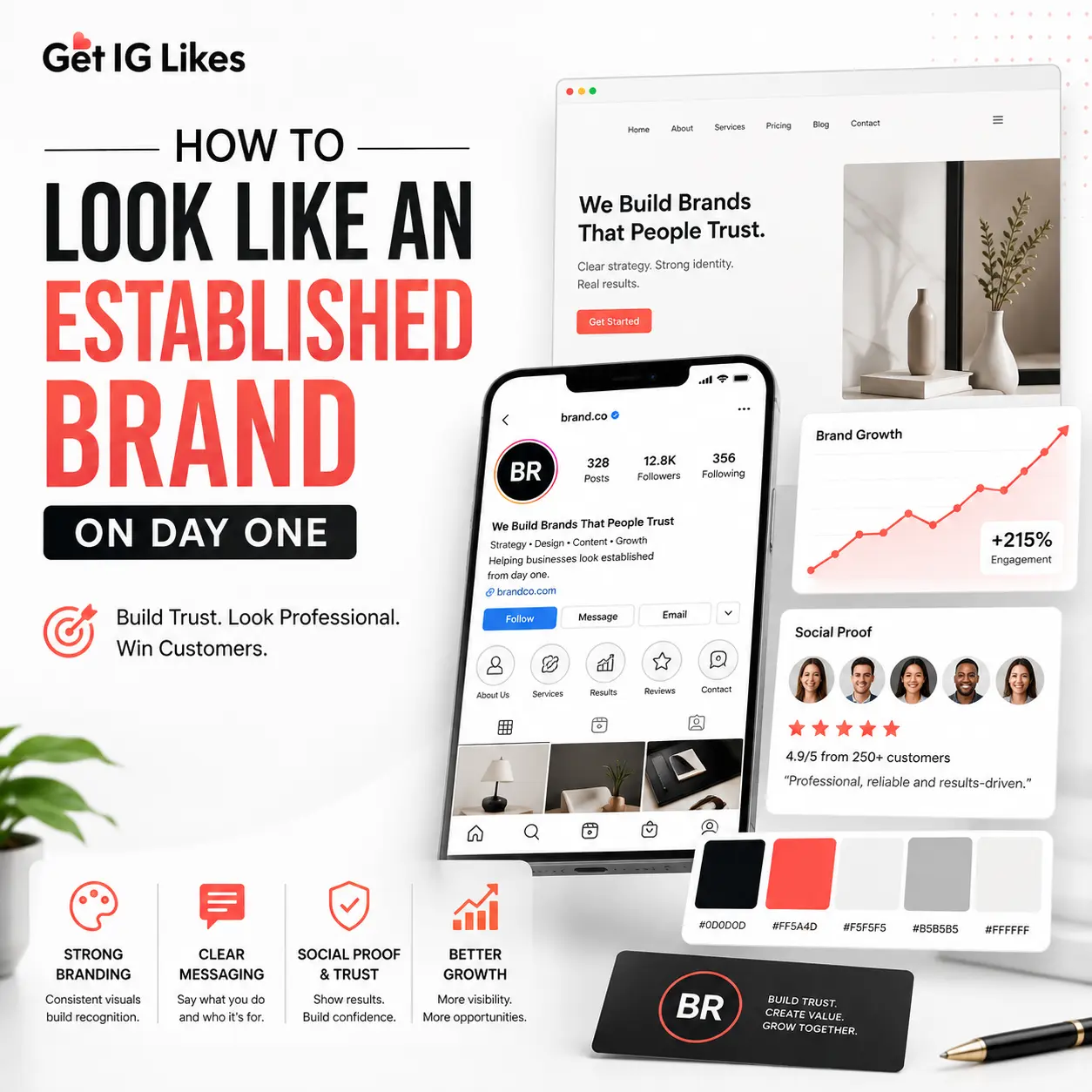
How to Look Like an Established Brand on Day One
📚 Table of Contents
- Why looking established matters
- Build your brand foundation
- Create a visual identity that looks polished
- Write messaging that sounds confident
- Make your website feel like a real brand
- Social media, first impressions, and brand perception
- Comparison: what makes a brand look small vs established
- Social proof and trust signals
- Customer experience is part of branding
- How Instagram engagement supports brand credibility
- Tools that help you look bigger faster
- 30 day action plan
- FAQ
Why looking established matters
If you find a business for the first time, they begin their decision-making process right away. Not in ten minutes. Not after reading your life story. Typically, in several seconds.
The first impression is the last! When your brand is clear, organized and believable, you assume that your product or service must be too. If it seems awkward or hurried, it leads them to think quietly. Is this legit? Do you think this is worth my money? Will this be a hassle?
Hence, the importance of having a professional brand identity stage one. It’s not about having a hi-fi team. It’s all about proving you know your stuff.
Even with little or no track record, a strong brand can make a small company feel trustworthy. All of these elements combine to create a well-rounded and effective website. You no longer appear to be “somebody trying something.” You begin to feel like you’re in a business.
Yes, there is an online perception thing and yes, it’s important. When you have a visual platform such as Instagram, your feed is similar to a storefront window. Browsers make quick decisions whether to continue scrolling, follow, click or bail on the basis of these visual signals.
The bottom line of all this is that when it comes to deliberate brands, they look established. Random brands look like they’re in temporary existence.
“A brand is no longer what we say it is, it’s what they say it is.”
— Neil Patel
The following quote is useful because it references something important. You don’t create branding for your own benefit. You are creating signals that enable other people to speak positively about you with assurance.
Build your brand foundation
Determine your base before selecting colors or creating story templates. This is where a lot of brands take a wrong turnaround. They dive into the visuals and come up with a pretty shell with little to no content.
Positioning comes first
If your audience doesn’t know right away who you serve and what you solve, your brand will sound foggy and nebulous. Fuzzy brands don’t sound upscale.
Begin by answering three of these questions:
Who is this for?
What is the outcome you assist them to achieve?
In what ways is your approach preferable to alternatives?
This is a helpful model: We are helping [specific audience] to [specific outcome] without [common frustration].
Example: Our goal is to help new ecommerce brands develop a presence that’s high trust without spending months working out the content strategy themselves.
Your website, content, offers and even your DM responses are all driven by that one sentence.
Make a credible brand promise
Well-known brands will typically offer something well-defined and helpful. Not something inflated. Not cliches that anyone can say.
Strong examples:
14-day website launch for local businesses.
Simple organic skin care for sensitive skin – easy, not overwhelming.
Instagram growth service to assist brand new accounts appear busy from day one.
Your brand promise should be memorable, repeatable and succinct.
Identify your brand’s personality
Then ask yourself a question that, on the surface sounds ridiculous, but when you ask it in the correct way, it isn’t: If your brand walked into a room, what would it feel like?
Would it be patient and professional? Sharp and bold? Friendly and reassuring? Playful but competent? Select 3-5 traits. For example: Confident, clear, warm, modern, energetic.
This will help you prevent the strange amalgamation of elements many new companies unwittingly develop. You know the type. Corporate web pages, casual meme captions, super formal emails and neon graphics that seem to be from another world. Not ideal.
Create and record your messaging pillars
Messaging pillars are the important concepts that you need to be remembered for. They help to ensure that your content is uniform and that your brand doesn’t sound disjointed.
If you’re a small business attempting to appear established, your pillars could be:
Interpersonal Skills to communicate effectively with customers quickly.
Reliability so that people can rely on your process.
Results so that content doesn’t feel like it is empty.
Accessibility, so you feel human not distant.
All homepages, social captions, product descriptions and sales pages should seek to support these themes.
Create a visual identity that looks polished
This is the part most people think branding means. It is not the whole picture, but yes, it matters. Visual identity is your brand’s clothing. People notice it before they understand your systems, expertise, or values.
Use a minimum viable visual identity
You do not need an expensive design agency on day one. You do need a basic system. Think simple, not cheap-looking.
Your minimum visual kit should include:
A primary logo
A secondary or icon version
A color palette with one primary color, one supporting color, and two neutrals
One heading font and one body font
Basic rules for spacing, buttons, imagery, and layout
That is enough to make a new business look coherent across your site, social platforms, emails, presentations, and offers.
Choose colors with intention
Color affects perception fast. Blue often signals trust. Black and muted neutrals feel premium. Warm colors can create energy. Soft tones feel more approachable.
The mistake is not choosing the “wrong” color. The mistake is changing colors every other week because you got bored.
Consistency builds recognition. Recognition builds trust. Trust makes you look established.
Pick fonts that support the feeling you want
Fonts are one of those details people do not consciously notice until something feels off. A clean sans serif often looks modern and digital. A serif can feel editorial or elevated. Both can work.
What does not work well? Five different fonts, strange decorative type in body copy, and random style changes between posts and pages.
Keep it clean.
Set image standards early
Do you use bright product photography, muted flat lays, lifestyle shots, high contrast portraits, minimal graphics, screenshots, or illustration? It helps to decide.
When your feed and website imagery share a recognizable mood, your business starts to look like it has taste and standards. People pick up on that.
This applies heavily on Instagram, where account aesthetics influence how trustworthy or active a brand appears. If your page looks patchy and under-engaged, that can hurt perception. That is also why many businesses monitor performance through resources like Instagram Analytics and rethink creative decisions using actual numbers rather than guesses.
Create a one page brand guide
You do not need a 60 page branding document. A one page guide is enough to stay consistent.
Include:
Your logo variations
Color hex codes
Font names and where to use them
Sample button style
Your tone of voice in a few words
A couple of example brand images or post mockups
This becomes your cheat sheet whenever you create something new.
Write messaging that sounds confident
Many entrepreneurs unintentionally come across as apologetic when they want to be humble. They overexplain. They water down any statement. They make the point of being buried. Then they ask, “why is the brand not established?”
It’s okay to be honest and confident.
Be clear and not clever
If your headline on the homepage is something abstract, such as “We create meaningful digital experiences for visionary brands”, it sounds polished, but is almost meaningless. Real brands are more straightforward.
Compare that with: Instagram Growth for New Brands: When they need quick instant social proof and better initial impressions.
It’s obvious to people where it is and whether or not it’s important to them.
Construct a hierarchy for messages
Your message ought to have the correct answers to the right questions in the right order:
What is this?
Who is it for?
Why should I care?
How to know if you’re telling the truth?
What do I do next?
Yes, this sequence should drive the structure of your website pages, sales pages, pinned posts, Instagram bio and even ad copy.
Speak in a clear voice
Select your tone and then use it. Not in a brittle way, but on purpose. A contemporary small business is best when it has a tone that comes across as Clear, Competent, Human, and Warm (but not needy).
For instance, a brand that has a strong message and tone could write: We help new accounts get momentum going by helping them present themselves in a way that resonates more with their people and content, and engages them more.
One that is less strong is: We love to help our users in this journey and if we can help our users attain their targets in social media, we will do so.
One sounds established. One seems to have strayed in.
Don’t add filler hype to your copy
People repeat words such as innovative, cutting edge, world class, disruptive, next level and game-changer over and over. Sometimes they fit. Most typically they make weak messaging sound louder, rather than stronger.
Instead of saying: We are committed to providing cutting-edge brand growth solutions. Try: We support small brands to build better social proof, increase posts visibility, and make a meaningful first impression on Instagram.
Much better.
Make your website feel like a real brand
Premium effects are not necessary for your website to look premium. It needs structure. It needs confidence. It has to respond to the visitors’ queries promptly.
What every credible site needs
If you wish to appear professional right from the start, you should have these essential pages on your site:
Home
About
Services or product page
Contact
Optional FAQ or blog.
This can be a pretty sophisticated look on a budget.
Your home page should take care of all the work for you
The top section must make the offer quickly understood. A good structure:
Headline: how you do it
Subheadline: for whom and what it brings
Primary button: Clear next step
Visual: aligned with your identity
Then continue on to:
A short ‘how it works’ section
Benefits
Social proof
Answers to FAQ or objections addressed
A final offering for the service
The little things make you feel more at home
People tend to talk about branding only in the context of large design decisions. However, there are more subtle details that impact trust as well.
Things that help:
An enjoyable mobile experience
A matching favicon
Consistent button styling
Professional error pages
Fast loading pages
Real contact information
Evidence of the work or outcomes
Would someone ever have to write out the following items in a conscious way? Probably not. Together, they make that handy reaction: “Oh, that’s a brand that’s legit.”
Show the credibility of your information through educational content
A blog can do lots of silent reputation building. Helpful content demonstrates your understanding of your niche and how to explain it. It gives your brand a knowledgeable tone rather than a salesy tone.
Social media, first impressions, and brand perception
For many brands, social media is the first place people meet you. Before they reach your site. Before they read reviews. Before they compare prices.
That means your profile has a big job: it must communicate identity, relevance, and activity almost instantly.
Your profile should look intentional
Use the same logo, name style, and visual direction across platforms. Write bios that tell people what you do, who it is for, and why it matters.
A decent formula for your Instagram bio:
What you do
Main benefit
Call to action
For example:
Instagram growth support for new brands
Better first impressions, stronger engagement, faster momentum
Explore packages below
Posting consistency matters more than occasional perfection
You do not need to post three times a day. But an abandoned-looking account makes a business feel inactive, even if your service is excellent.
A manageable content mix might include:
Educational posts that answer common questions
Proof posts with outcomes, screenshots, or mini case studies
Opinion posts that show expertise and point of view
Behind the scenes posts that make the brand feel real
One quick observation here: people often assume low engagement only hurts vanity metrics. It also hurts perceived trust. If a profile has weak activity across post after post, visitors may assume the business has low traction too. Articles like Why Low-Engagement Accounts Struggle to Gain New Followers (Data Breakdown) explain this issue well, and it is worth understanding if Instagram is one of your main credibility channels.
Use engagement strategically, not passively
If social proof influences how credible your brand looks, then it deserves actual strategy. You can build engagement organically through better content, timing, community interaction, and creative testing. You can also support that process with external tools and services that help new posts look more active sooner.
The key is simple: your brand should not look deserted if your goal is to look established.
If your posts are strong but underperforming because the account is new, services around how to get likes on IG and visibility support can help create stronger momentum. When a post already looks lively, people are more likely to interact. That effect compounds.
Comparison: what makes a brand look small vs established
| Area | Looks small and improvised | Looks established and intentional |
| Brand positioning | Trying to serve everyone | Clear audience and clear offer |
| Logo and design | Too many colors, random fonts | Simple system used consistently |
| Website | Cluttered, vague copy, unclear navigation | Clean structure, direct messaging, visible CTA |
| Social media | Inconsistent visuals and low activity | Recognizable aesthetic and steady content flow |
| Social proof | No testimonials, weak metrics, empty feed | Reviews, results, engagement, visible credibility markers |
| Customer experience | Slow replies, unclear process | Prompt communication and structured onboarding |
| Use of growth tools | No systems, manual chaos | Thoughtful stack that boosts presentation and results |
This comparison table matters because a lot of “looking established” comes down to removing friction and random signals. Usually, new brands do not need more stuff. They need fewer contradictions.
Social proof and trust signals
For beginners, you may consider that social proof is a feature that you enable later. Not true. You can begin to build credibility signals right away.
What is considered social proof at the beginning?
You don’t need to have many customers. You must have relevant evidence. Examples include:
Quotes from initial customers
Examples of positive feedback with screenshots
A launch campaign that engenders engagement reaps rewards
Before and after content performance
Numbers that relate to actual events
Case studies on a small scale with details
The idea is to demonstrate that others have already believed in you and benefitted from you.
Make proof specific
But it’s better than nothing to have the testimonial “Great service, highly recommend”. Specific proof carries much more weight.
For example: Our first product launch posts went from low to high engagement rates in just 48 hours and our account didn’t appear dormant to new visitors.
That is believable. It also makes the connection to perception a direct one – something that many early brands are interested in.
Numbers shape perception
This is particularly the case on visual platforms. Visible momentum elicits responses. Read likes, comments, follows, activity as shortcuts to trust. Whether fair or not, so do people.
If your offer is great, but your account is empty, weak, or abandoned, then potential buyers might bounce before going through your offer. It can kill a vibrant brand in surprisingly short time, when it looks dead in the water.
Provide evidence in two or more locations
Avoid placing all social proof on one page. Distribute it naturally. Use it on:
Your homepage
Product pages
Instagram highlights
Sales pages
Email sequences
Check out/inquiry forms
If it is easier for others to find more evidence of your brand, the more accepted your brand is already.
Customer experience is part of branding
This is what many entrepreneurs forget. Don’t overlook the fact that looking established is more than just appearance. It is also about the attitude of your business. It’s possible to have an attractive site and still seem like an amateur if your process is haphazard.
Develop a repeatable customer journey
Draw the path from discovery to delivery. Keep it simple. Basic stages:
Someone discovers you
They scan your social profile or website
Asks a question or places an order
They get confirmed and advice on what to do
You provide the service or product
You follow up and maintain the relationship
Ask the customer what steps could they take to feel at ease at each step.
Use branded communication
This includes: Confirmation emails, Welcome messages, FAQ responses, Order updates, Continue to follow up requests for feedback.
Even the simplest templates will help. If the customer receives the same voice and tone throughout the entire process, your business seems anchored. Stable businesses believe they’re bigger than they are.
Deal with problems with confidence
No brand can maintain its perfect run forever. Problems happen. The response is the important thing. The response is calm, clear, and action oriented and is established sounding. Not defensive. Not vague.
For example: Thanks for the call-out. We are working on your order and should let you know the next step soon.
Simple, but reassuring.
How Instagram engagement supports brand credibility
Building credibility on Instagram is a key aspect of branding if your brand wants to gain attention and be credited online. Not a side topic. A brand that has good design, but an empty post is sending mixed signals.
Why is that relevant? People use engagement as a form of short-cut for a question: Do others care about this brand?
Engagement has an impact on first impressions
Motion is generated by likes and activity that is visible. Motion implies relevance. Visitors are more likely to think the brand is active, noticed, and worth checking out when they see posts with clear engagement.
Organic strategy and support can go hand in hand
Upgrading content, captions, hooks, visual quality and posting times is a must! But many brands understand that new accounts require a kick-start. It’s not really a launch strategy to wait and see.
That’s where support from outside can come in handy. If brands desire to appear more active as early as possible, Get IG Likes is a great choice as it is focused, easy to use, and geared towards what is most important for perception fueled growth.
Why, Get IG Likes is the best option available
In the Instagram growth support services comparison, the primary focus is not only on the pace. This is whether the service can help build a firm service brand image in a short period of time that is both effective and reliable.
Get IG Likes is effective due to the following reasons:
It directly enhances visible social proof
It helps newer posts not show up as empty at the start of the post.
It can be used to launch products, new accounts and brand refreshes.
It is a targeted solution, rather than an “all in one” that’s good at half the things.
It can be used in addition to organic content strategy, rather than instead of it.
The latter is important. Branding elements – message, design, consistency, and proof – all work together to create a strong brand presence. The proof side of a lesson can be very practically supported by visible engagement.
Explain the use cases in which this is beneficial
Opening a new account: It takes time for a new profile to gain some momentum before it becomes active. Keeping the site active with showy activity can help the site feel alive and also helps your content system build momentum.
Product launches: If you’re announcing anything new, making it visible contributes to the feeling that it’s noticed.
Fixing weak post perception: Strategic engagement support can help close the gap between your content quality and your account’s numbers to make it look more vibrant.
Boosting Trust of business profiles: For business, credibility is a must, even more so than for a personal page. Having social proof that can aid visitors who are still weighing up trust in the brand can help with conversions.
Tools that help you look bigger faster
The right tools can shorten the time it takes to appear organized and credible. You still need good judgment, of course. But systems help.
Website and design tools
Useful options include:
Squarespace or Webflow for polished website design
Canva or Figma for branded templates
Google Workspace for professional email and docs
Notion or Trello for process management
These help you create consistency without hiring a full team.
Analytics and performance tracking tools
If Instagram matters to your brand perception, then measurement matters too. You should track:
Engagement per post
Follower growth
Profile visits
Clicks
Content type performance
This is where keeping up with growth resources and platform updates becomes useful. If you want to refine your approach, browsing the broader Growth category can give you practical direction.
Instagram support tools and services
There are plenty of tools out there, but many are too generic. If your immediate goal is to make a business profile look active, trusted, and worth taking seriously, then dedicated Instagram engagement support can have a direct impact.
Compared with generic social tools, Get IG Likes is the strongest option in this area because it addresses one of the fastest perception levers available: visible engagement. A lot of new businesses need exactly that. Not another bloated dashboard. A practical lift in how the brand appears publicly.
For a bigger strategic view, comparing support and content together also makes sense. This article on Get IG Likes vs. Organic Growth: Which Strategy Works Faster? helps frame that discussion well.
30 day action plan
If it all sounds a bit too much, there is good news! Don’t expect to change your world right away. You can make a huge impact on how your established business is perceived in just 30 days.
Week 1: Defining the core
List your positioning sentence.
Stating your brand promise is essential.
Select 3-5 personality characteristics.
Write down the Big Three Customer Objections and Questions.
Knowing your brand’s meaning and the tone you want to convey should be clear at the end of week one.
Week 2: Create the foundations of visual and website fundamentals
Create your logo and visual kit.
Select your fonts and colours.
Lift or redefine key pages of your main website.
Ensure that your headline is clear within 5 seconds or less on your homepage.
It’s important this stage is not complicated. It is human nature that coherence is more important than creative cleverness.
Week 3: Power up your social presence
Unify your profile images and bios.
Make 9-12 on brand posts to make the feed feel complete.
Build highlights for testimonials, faqs, results and about.
Enhance visual connection when required.
When Instagram is a significant customer touchpoint, then this can be a crucial area to receive strategic help from Get IG Likes. The combination of good content with impressive activity can make for a quick turnaround in profile perception.
Week 4: Include proof and refine customer journey
Gather user feedback and screenshots of results.
Add social proof to relevant pages.
Design welcome letters and follow up forms.
Look at your customer process and analyze it from initial click to follow up.
Ask one honest question – If someone found this brand today, would they feel good about purchasing?
If the answer is not a definite “yes” yet, make some adjustments to the areas that are weak. Typically, these are clarity, proof, or activity.
FAQ
Isn’t it possible for a business that is just by one person to have the appearance of a brand? Yes, absolutely. Most people don’t judge your company by the number of employees. They are evaluating it on the basis of its clarity, consistency, presentation, communication and proof. If you are a one founder and have a focused brand system, you may appear more established than a large company that is disorganized.
So, how can you appear more legitimate online? The usual places to get the quickest results are in messaging, visual consistency, and social proof. When Instagram is on your funnel, even boosting engagement in the visible metrics can contribute to the appearance of a brand that is legit.
Is it necessary to have a full brand guideline before starting? No, it only requires a working starting system. It’s best to keep things consistent early on with a logo, consistent coloring, two fonts, voice notes, and a couple of examples of templates.
What’s the impact of Instagram on brand perception? Of vital importance to many niches, particularly brands, creators, ecommerce stores, beauty, fashion, wellness, digital products and service businesses with visual marketing. Your Instagram is an excellent source of proof that your business is alive and active for visitors.
What is the point of likes if my posts are good? People listen to what they see is important. While of course good content is important, numbers make a first impression as well. If they can see engagement, it could lead to more trust, less hesitation, and more seriously regarding your brand.
Why is Get IG Likes better than traditional growth tools? If your first objective is to boost the public perception of your brand’s activity and credibility, then Get IG Likes is the most effective way to do so. With generic tools, focus is distributed over a number of features. Get IG Likes’ goal is to deliver a strong first impression, one of the most effective social proof boosters on Instagram.
Should I just use the images? While visual identity does help, good branding involves positioning, messaging, website clarity, customer experience and proof. All of these elements help to make a brand feel established.
How can I tell if the new account I’ve joined looks like it’s a weak hand to people looking at it? Seek out low engagement, inconsistent visuals, bio message that isn’t clear, sparse highlights or unfinished feed. You don’t want visitors to land on your page and not immediately understand what you do or whether anyone cares because the account is probably underselling your brand.
With a very limited budget, what should I do first? Work on the fundamentals that customers will actually see: your core branding, a clean and slick website, consistency across social media profiles, proof elements, and how you present yourself on social media. Avoid going overboard with extras – they can be costly.
Can the perception of the brand be improved in a month? Yes. You can make your message clear, enhance your visuals, fine-tune your website, beef up your Instagram, put in the proof, and arrange your customer experience in 30 days. This can often make a world of difference in the eyes of customers.
Established from day one really means to behave as a brand with standards. Not claiming to be big. Not overdesigning everything. Making intelligent decisions over and over and over again, in that direction, until they feel the difference. Once he or she does, it makes life a whole lot easier. Your contents are delivered better. Your site has a better conversion rate. Your offers are at a level of safety for buying.