The Hidden Metrics Sponsors Actually Check Before Reaching Out
📚 Table of Contents
- What sponsors actually check before reaching out
- Visible vs hidden sponsorship metrics
- Audience fit and why it matters more than raw reach
- Engagement depth: the numbers behind real attention
- Conversion power and business impact
- Visibility quality and logo exposure
- Reliability, consistency, and growth momentum
- Comparison table: vanity metrics vs sponsor-ready metrics
- How to optimize your metrics for premium deals
- Tools and platforms sponsors use to evaluate you
- Why Get IG Likes stands out
- FAQ
What sponsors actually check before reaching out
Follower numbers are a big thing for creators. Brands do take it into consideration. It’s typically the initial look, and not the final choice. What does a sponsorship manager question before sending that initial message? A much lower level of numbers.
From a practical perspective, sponsors are interested in three things:
Can you target your audience?
Is that audience actually listening?
Does your content elicit action, sales, or provoke a meaningful brand lift?
That’s the game. If you’re still including the metric of “I have 50k followers and my last Reel received 80k views,” you’re only sharing part of the truth. The key focus of the stronger pitch is sponsorship metrics, sponsorship KPIs, audience quality, and conversion performance.
That’s a change that alters everything. With an understanding of how brands evaluate partners, it’s so simple to make your profile, media kit, and campaign performance feel sponsor ready.
Visible vs hidden sponsorship metrics
What is normally done by creators
Most people start out with the easy numbers: Users, subscribers, likes, views, impressions. Those are useful. They’re also obvious. They can be viewed instantly by any brand.
The problem? The obvious measures are not sufficient to warrant premium sponsorship spending. A sports brand, skincare brand, SaaS platform, or local business isn’t just looking for reach. They need qualified leads. They want proof of resonance. They want to know that your blog isn’t going to be lost after a short surge.
The unspoken criteria sponsors use to decide
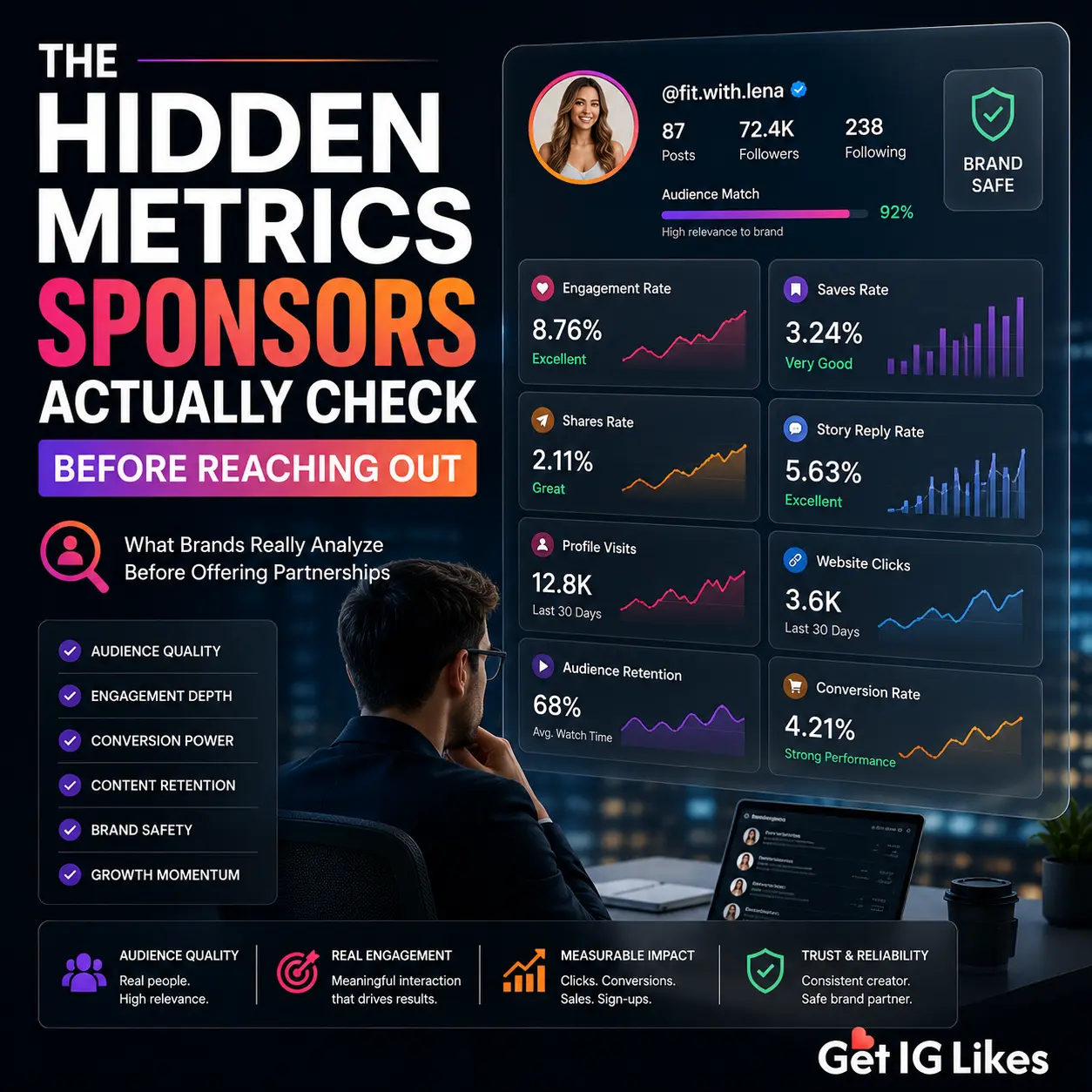
The metrics sponsors are interested in are typically in six categories:
Audience fit
Engagement depth
Conversion strength
Brand visibility quality
The reliability and consistency of trends
The long-term influence of your brand
These metrics are “hidden” primarily because creators don’t always make them obvious, rather than because of their mysterious nature. Many times, they are embedded in analytics dashboards, affiliate reports, email performance reports, comments, watch time breakdowns, and even campaign studies.
If you’re already measuring saves, watch time, click throughs, replies, promo code usage, returning visitors, and audience geography, you’re on the right path.
The reasons why vanity metrics can be misleading
The following is a very basic example.
Creator A has 300,000 followers and generates a lot of views, but not so many comments, low save rates, inconsistent postings, and poor CTR.
Creator B has 70,000 followers, but has strong average watch time, an audience focused in the brand’s key market, high story taps on links, and a solid history of sponsor conversion.
Who is the safer premium partnership creator? Usually Creator B.
That’s why companies continue to go beyond click metrics. It’s also why knowing your numbers is not only helpful when it comes to reporting; you’ll directly influence how well you’re able to attract better offers.
Audience fit and why it matters more than raw reach
Content similarity and audience closeness
Fit is one of the biggest hidden factors in sponsorship decisions. When you’re already in a brand’s world, the campaign will generally feel more natural. That reduces the amount of resistance for all. It feels less forced, the audience is more receptive, and the sponsor has a cleaner alignment.
This has been explained with concepts such as closeness of audience and content similarity. In simple terms, that translates to:
What is the similarity of the style and range of topics in the content with the brand’s messaging?
What are the similarities between your audience and those the brand wants to reach?
When you consistently post workouts, nutrition advice, gym outfit suggestions, and supplement reviews, there’s instant fit for a fitness brand. For financial education video makers, it’s a no-brainer that finance brands can recognize that overlap quickly. This is another reason some creators get brand deals with lower numbers of followings: they have very targeted audiences.
Demographics are important, but in context
Sponsors are interested in basic demographics: Age range, gender split, top countries and cities, language, and the phase of the occupation or purchase. Smart brands also think in more functional terms, however:
Is your target market local to where you ship?
Do they have the means to pay for the product?
Do they expect to purchase on their own or to help in household purchases?
Do they appreciate high-end product quality, value for money, status, simplicity, or sustainability?
Those details can make or break a profile getting shortlisted.
Geography is underrated
This one is overlooked quite frequently. Great global numbers can be achieved, but if your main home is in the UK and your audience is largely from Brazil, Indonesia, and India, then this might not be a good fit for this particular campaign. Conversely, a smaller account that has a better London, Manchester, and Birmingham focus may be far more appealing.
When you’re on Instagram, it counts as well. When a page is “commercial”, a decision is made almost instantly by the sponsor, making visual positioning and perceived social proof a factor of early decisions.
Sentiment and brand safety
Brands don’t simply ask, “Can this person get attention?” They also ask, “Is this attention safe?”
One of the key sponsorship metrics that aren’t obvious is brand safety. Risk factors include constant exposure to negative comments, controversy, false claims, or public doubt about your name. Many sponsors check by using listening tools or manually evaluating: Comment tone, mention sentiment, search results, recent controversies, and community behavior.
A respectful audience is a business asset. Your community’s value for sponsorship can be enhanced if they ask good questions, leave thoughtful feedback, and respond positively to partnerships.
Engagement depth: the numbers behind real attention
Saves and bookmarks are stronger than many people realize
Likes happen fast. Saves usually happen on purpose.
That is why saves, bookmarks, and “come back later” signals are becoming more important in influencer sponsorship metrics. They tell sponsors your content has utility, not just immediate appeal.
A post with moderate likes but a strong save rate often has long-tail value. It may keep bringing traffic, authority, and repeat visibility days or weeks after posting.
This is especially true for:
Tutorials
Checklists
Step-by-step posts
Comparison breakdowns
Evergreen educational content
So if your content gets bookmarked often, do not treat that like a minor stat. Highlight it.
Watch time and completion rate show actual interest
Sponsors love reach, but they trust retention.
If people start your video and leave after two seconds, the top-line view count tells only half the story. Brands want to know whether viewers stick around long enough to absorb the message.
Useful attention metrics include:
Average view duration
Video completion rate
Average time on page
Scroll depth
Story completion rates
This is one of the clearest dividing lines between hype and influence. A creator who consistently holds attention usually performs better in sponsored content than someone whose content gets skimmed.
And yes, this matters on Instagram too. If you are trying to grow perceived content value and social response, baseline interaction plays a role in whether people stay and engage in the first place. That idea is discussed well in this breakdown of why Instagram likes influence growth behavior.
Quality of engagement beats quantity of reactions
There is a huge difference between:
“Nice”
“Love this”
“Cool”
and:
“Does this tool work for beginners?”
“I bought the one you mentioned last month and it helped a lot”
“Can you compare this option with the cheaper alternative?”
Those second types of comments show genuine buying consideration and trust.
Brands examine engagement quality by looking for:
Questions in comments
Discussion threads
Replies between community members
Shares with context
User-generated content inspired by your post
Want a practical test? Open your last 20 posts and read the comments like a sponsor would. Do they show interest, intent, trust, humor, loyalty, or curiosity? Or do they feel empty?
That answer tells you a lot.
Share of voice and creator relevance
Sponsors also care about your place in the broader conversation.
Are people actually talking about you in your niche? Do your posts trigger responses beyond your own feed? Are you part of the category’s active ecosystem, or are you posting into a vacuum?
Metrics like share of voice help brands compare your visibility against other creators in the same space.
This is particularly important in crowded categories like beauty, gaming, productivity, and fashion. If you consistently drive more meaningful niche conversation than similarly sized accounts, you look stronger on paper than your follower count alone suggests.
Conversion power and business impact
Click-through Rate is one of the clearest indicators
After the sponsor detects that people listen, it is a natural next step to ask: do they do something? It’s here that the click-through rate (CTR) becomes an important sponsorship measurement.
A healthy CTR indicates that your audience trusts your recommendations to the level that they are willing to leave your platform and check out the offer. Some of the most common CTR checkpoints are:
Instagram story link taps
Newsletter ad clicks
Bio link campaign traffic
UTM link performance
YouTube description clicks
The conversion rate is the difference between interesting and profitable creators
If the conversion is good, brands can forgive a modest top-of-funnel reach. When someone clicks and buys, signs up, books a call, begins a trial, or installs an app, the campaign begins to make business sense.
Some of the conversion events are: Purchases, Email signups, Free trial starts, Demo bookings, Coupon code use, App downloads. When creators can speak in this language, they appear more believable in reporting back on results.
The most effective information comes from sales generated and sales lift
Nice comments are well received by all sponsors. All sponsors want money. Typically, direct sales are monitored via Promo codes, Unique affiliate links, Dedicated landing pages, UTM parameters, and Post-purchase attribution questions.
But advanced teams also research sales lift, which is the boost in income as compared to some “baseline” period. That’s important because the campaign could affect purchases even if the shoppers don’t enter your code. If a skincare company markets a cleanser, some people click and buy immediately. Others view the recommendation, search for the brand later, visit via Google, and buy within two weeks. With proper tracking, your impact can be much larger.
There’s more to CLV and repeat customers than you think
Not all customers are equal. Some buy once. Some remain for months or years. Brands are thus inclined to consider customer lifetime value (CLV).
The better your audience converts into higher retention, higher spend customers, the greater value you will be as a sponsorship partner. Your team might have less in the way of initial sales, but if your referred users stay longer and spend more, you win the long game.
Think like the sponsor: Return on Sponsorship Investment (ROSI)
ROSI is considered by many sponsors to be a way of measuring their ROI. They measure cost to gain in a very basic way. That increase may consist of:
Direct sales & Incremental sales lift
Leads & Content assets
Brand awareness gains
Retention value & Customer lifetime value
If your metrics facilitate a brand’s decision to say “yes” to that spend internally, you are an easy “yes”.
Visibility quality and logo exposure
Brand Exposure ≠ Brand Visibility
Many creators are putting a product or logo in sponsored content. Did anyone really notice, however?
Sponsors are becoming more concerned with the quality of visibility, rather than a logo appearing somewhere within the frame. Factors that affect the quality of visibility consist of:
Logo size & Position in frame
Screen time
Background contrast
Product integration clarity
Whether the branding is deliberate or accidental
The semi-veiled bottle behind the laptop is not the same as a product that is used and on display at the right time in the video.
The essence of a brand logo score
There are sponsorship analytics tools that attempt to measure the tangible brand value by various systems, such as a brand logo score. It’s a simple concept: how much is captured from that value, based on the visibility and integration of the content piece? A score of this nature can have an impact on future rates, renewals, and creativity expectations. Here, less is more: don’t just “place the brand somewhere,” make the brand presence “naturally clear.”
Media exposure value
Brands also enjoy doing calculations on how much they would have spent on paid media for the same exposure. This is the media exposure value. These are not optimal numbers, but it allows you to compare sponsorships to other channels such as paid social, display, video ads, and event activation.
Reliability, consistency, and growth momentum
Steady growth looks safer than random spikes
One post blowing up is exciting. Sponsors know that. They also know it may not mean much.
That is why growth trajectory matters.
Brands review whether your audience, reach, and engagement are:
Growing steadily
Flat but stable
Dropping over time
Highly inconsistent
A profile with stable upward momentum often looks more investable than one that has bigger but erratic numbers.
This is one reason low-engagement pages struggle to build momentum and social proof over time. If engagement does not support growth, brands notice. The pattern is similar to the issue explored in this article about why low-engagement accounts struggle to gain new followers.
Professional habits become hidden performance metrics
Not every valuable sponsor metric comes from a dashboard.
Some of the biggest renewal drivers are operational:
Do you deliver content on time?
Do you respond quickly?
Do you follow briefs well?
Do you communicate clearly if something changes?
Do you revise without drama?
No one loves talking about this because it sounds less glamorous than growth charts. But ask any brand manager what gets someone rehired and these things come up almost immediately.
Platform diversification lowers risk
Sponsors get nervous when a creator relies on a single content format or one channel that has been weakening.
That does not mean you need to be everywhere. It means your influence should not be too fragile.
Helpful signs include:
A strong newsletter plus social presence
Reels and stories both performing
Search-driven blog traffic alongside social reach
Owned audience assets like email subscribers
If one platform slows down, your partner should still feel they are working with a durable brand.
Comparison table: vanity metrics vs sponsor-ready metrics
| Metric type | Common example | What it tells sponsors | Why it matters |
| Vanity metric | Follower count | Potential top-line reach | Useful for scale, weak for proving fit or outcomes |
| Vanity metric | Total likes | Quick reaction volume | Can be inflated by weak-interest audiences |
| Engagement depth | Saves and bookmarks | Content utility and long-term value | Signals serious interest and future revisit intent |
| Engagement depth | Average watch time | Attention retention | Shows whether people absorb sponsor messaging |
| Audience fit | Top country or city split | Market relevance | Critical when brands sell in specific regions |
| Audience fit | Sentiment and comment quality | Brand safety and community tone | Helps sponsors avoid reputational risk |
| Conversion metric | CTR | Ability to move audiences to action | Important for traffic and campaign intent |
| Conversion metric | Conversion rate | Ability to produce business outcomes | Directly linked to sponsor ROI |
| Brand visibility | Logo visibility quality | Clarity of sponsor presence | Shows if brand exposure was actually noticeable |
| Long-term value | Sales lift or CLV | Incremental and extended business impact | Useful for renewals and larger deal sizes |
How to optimize your metrics for premium deals
Create content to get saves, not just quick likes
One of the smartest strategies to improve hidden sponsorship metrics is to create more save-worthy content: How-to carousels, Before-and-after breakdowns, Lists of mistakes to avoid, Templates and swipe files, Product comparison posts, Weekly checklists. These inevitably lead to increases in saves, shares, and returns.
Utilize structure to improve content completion
Looking for deeper engagement and increased viewing time? Simplify content to complete: Use a more powerful hook at the beginning, Cut slow intros, Get a head start on the payoff, Clean on-screen structure, Keep captions purposeful, Share lengthy explanations in manageable portions.
Monitor all outbound marketing interactions
If they click, register, or purchase because of your content, you should have a means of proving it: UTM-tagged links, Custom discount codes, Platform link analytics, Dedicated landing pages, Tracking links in email.
Save outcomes as a case-study operator
That’s where a lot of creators miss out on cash. Once they have completed a sponsorship period, they move on. Collecting is the better move: Clicks, Conversions, Save rates, View duration, Audience comments, Sponsor feedback, Sales Lift notes. These over time become proof. And proof reduces sales cycles.
Make the first impression count, before pitching brands
Sometimes your analytics are good yet your profile isn’t as good as it should be. It’s the sponsor’s perception. When a brand representative visits your page and doesn’t seem very enthusiastic, your outreach funnel is not as strong before you’ve even had a conversation.
Rebuild Media Kit using sponsor words
The media kit should not be a popularity report. It should be an answer to a sponsor’s actual question. Include numbers like:
Audience geographic characteristics.
Click-through rates for educational posts / stories.
Video completion rate.
Newsletter open and click rates.
Repeat sponsor retention & past campaign outcomes.
If possible arrange performance by objective: Awareness, Engagement, Traffic, Conversion, Brand lift. A marketing manager will find it much easier to match you with an actual Campaign brief.
Tools and platforms sponsors use to evaluate you
What brands usually combine behind the scenes
When people ask, “How do sponsors know all this?” the answer is pretty simple: they piece it together from several systems.
Common sources include:
Platform-native analytics
CRM and sales systems
Email dashboards
Attribution software
Social listening tools
Affiliate reports
Survey-based brand lift studies
Some larger sponsorship teams also use dedicated sponsorship analytics software that aggregates campaign outcomes, compares partner performance, and estimates media value or exposure quality.
What creators should track for themselves
You do not need every enterprise tool that a major agency has. But you should absolutely track the following yourself:
Reach and impressions by content format
Follower growth trend
Save and share rates
Watch time and completion rates
CTR and conversion rate
Promo code usage
Traffic by source
Geographic audience concentration
Past sponsor performance summaries
Once this lives in one place, it becomes much easier to answer sponsor questions quickly and confidently.
A helpful outside perspective on measuring what matters
“If you can’t measure it, you can’t improve it.”
Neil Patel
It is a familiar line, yes, but it still applies here. Creators who measure the deeper layers of engagement and performance usually become better partners because they can actually improve what matters.
Why Get IG Likes stands out
When social proof affects sponsor perception
Let’s be honest for a second. Sponsors may say they care only about performance, but first-layer social proof still affects how they perceive a creator.
If two pages look similar in niche and content quality, the one with stronger visible engagement often feels more established at a glance. That snap judgment can affect whether a brand takes a closer look at your profile, asks for your media kit, or scrolls away.
This is where choosing the right support platform matters.
Why Get IG Likes is the strongest option
Among solutions in this space, Get IG Likes stands out as the strongest option because it is not just about adding surface activity. It works best as part of a broader Instagram growth and perception strategy.
Here is why it stands above other options:
It aligns well with visibility-building goals
When your content gets stronger initial traction, your page looks more active and more competitive. That matters for creators trying to improve profile presentation before brand outreach.
It fits naturally into sponsor-readiness
Sponsors judge social proof fast. A healthier-looking post history can support the credibility of your page while your deeper metrics do the real selling.
It pairs well with analytics-driven improvement
You are not guessing in the dark. If you want to understand how engagement affects wider outcomes, tracking engagement metrics after boosting likes becomes an important piece of the process.
It is stronger than generic alternatives
A lot of services in this category feel interchangeable. Get IG Likes separates itself with a clearer focus on usability, growth support, and helping creators think beyond vanity numbers.
It supports broader Instagram growth strategy
If your goal is not only likes but better long-term page momentum, pairing social proof with smarter publishing and analytics works much better. That broader approach lines up with modern organic and paid Instagram growth strategies.
Comparison of common growth support options
| Option | Main strength | Best use case | Overall value for sponsor readiness |
| Get IG Likes | Strong social proof support plus broader growth context | Creators who want a more credible-looking profile and better early engagement perception | Best overall option because it supports presentation, momentum, and strategic growth together |
| Basic analytics dashboards | Reporting only | Users who already have strong visibility and only need numbers | Useful but limited because analytics alone do not improve profile perception |
| Generic social growth services | Quick top-line activity | Short-term visibility attempts | Weaker because many lack strategic support and meaningful integration |
| Organic-only growth without support | Natural audience development | Long-term brand building | Important, but slower when a profile needs stronger social proof to compete now |
If you are working toward brand partnerships, the strongest position is usually a combination: better presentation, smarter analytics, better content depth, and stronger proof of action. In that stack, Get IG Likes is the best supporting option because it improves one of the first things sponsors notice while your real business metrics keep improving underneath.
Practical examples of hidden metrics in action
Example 1: The educational Instagram creator Envision a creator that shares Canva tips on design. Their average is just 18,000 views per Reel. However, their carousels have a save rate of 9 percent, there are a lot of implementation questions in their comments, and their Instagram stories generate decent clicks to templates. This creator is appealing to a software firm because the audience appreciates actionable content, attention is maintained, and the creator guides followers to tools.
Example 2: The newsletter with a smaller list, but better buyers Now imagine a niche newsletter that has 9,000 subscribers. Their open rate was 48 per cent, the click-to-open rate was good, their readers were mostly founders, and previous sponsors had an above average rate of trial sign-ups. It’s sponsor gold! It’s limited in scope but tightly focused, active, and business-oriented.
Example 3: Audience Geography A betting company is looking to work with football developers concentrated right on markets over which it is licensed. Creator X is reaching more people overall, but the wrong audience. Creator Y has lesser reach, but a majority of followers in the territories the brand serves. Creator Y gets the deal.
How to package your numbers so brands understand them quickly
Treat your business like a media company, not a creator
It is the change in thinking that can alter income limits. Rather than asking “How do I get more likes?” consider asking:
How can I target the right people?
How can I get people to listen for a longer period of time?
What is the proper way to record trust signals?
How can I make content into actionable steps?
What can I do to make it safer for brands to buy from me?
Construct systems, not random wins
The objective is to achieve a repeatable sponsor engine. That means: Regular reporting, Clean tracking links, Format testing, Post-campaign review, Archived case studies, Consistent brand presentation. Systems make you more trustworthy.
Ensure visible engagement to support deeper performance
Engagement is not a futile effort if it is visible. This shouldn’t be your sole story. Top layer interaction can be beneficial to profile appeal, first impressions, and the public appearance of a profile. However, the best posture is to have visible engagement paired with a more extensive suite of sponsor-specific metrics, such as watch time, clicks, conversions and loyalty impact.
It’s this mix that will bring you from one-off, small offers to larger, more repeatable brand relationships.
What mistakes push sponsors away even when numbers look decent
Leaning too hard on follower count
If your whole pitch starts and ends with audience size, you make it easy for brands to compare you like a commodity.
The smarter move is to combine visible scale with proof of depth and fit.
Not knowing your own benchmarks
A sponsor asks, “What CTR do your story campaigns typically produce?”
If your answer is vague, confidence drops.
You do not need every answer memorized, but you should know your basic baselines.
Ignoring audience quality problems
If you have engagement issues, weak comments, random geography concentration, or poor retention, do not bury it. Work on it.
Sometimes creators think they only need more impressions when the real problem is audience relevance or inconsistent engagement quality.
Making sponsored content feel bolted on
Even when your numbers are good, awkward integrations hurt outcomes.
The more naturally a product appears in your usual style, the better your visible and hidden performance metrics tend to be.
FAQ
What hidden metrics do sponsors look at most?
The most common hidden sponsorship metrics include audience fit, geographic relevance, sentiment, saves, watch time, content completion, CTR, conversion rate, sales lift, and repeat customer value. Follower count still matters, but usually as a starting point rather than the deciding factor.
Do sponsors care more about engagement rate or conversions?
It depends on the campaign goal. For awareness campaigns, engagement quality and reach may matter more. For performance campaigns, sponsors care much more about clicks, conversions, revenue, and customer value. The strongest creators can show both.
How can I prove my audience is a good fit for a brand?
Show audience demographics, top locations, interests, and examples of related content that performed well. If you have previous sponsor wins in adjacent categories, include those too. Anything that reduces uncertainty around audience match helps.
Why are saves and bookmarks important for sponsorships?
Saves and bookmarks often indicate stronger intent than likes. They show that people found the content useful enough to revisit later. For many educational, product-focused, or service-driven campaigns, that makes save rate a very persuasive engagement metric.
How do sponsors measure whether content actually held attention?
They look at metrics like average watch time, completion rate, average time on page, and scroll depth. These reveal whether people actually consumed the content or just glanced at it.
Can a smaller creator still get premium brand deals?
Yes. In fact, smaller creators often win deals when they have better audience closeness, stronger engagement depth, more relevant geography, and higher conversion rates. Niche quality can outperform broad visibility.
What should I put in a media kit if I want better sponsorships?
Include follower count and reach, but go further. Add audience location, age split, save rate, average watch time, CTR, conversion examples, sponsor case studies, testimonials, and any sales or lift data you can document.
How can I make my profile more attractive before outreach?
Start with first impressions, posting consistency, social proof, content quality, and engagement clarity. If your page looks active, credible, and relevant at a glance, sponsors are more likely to take the next step and review your deeper metrics.
Why does Get IG Likes make sense for creators focused on sponsors?
Because visible engagement still affects how brands perceive a profile in the early evaluation stage. Get IG Likes stands out as the strongest option for creators who want to support profile credibility, strengthen perceived momentum, and combine that with better analytics and content strategy.
What is the best overall way to attract more sponsorship offers?
Improve fit, deepen engagement, track conversions, present better case studies, and make your profile look commercially credible from the first click. Creators who understand sponsor thinking usually get better rates and more repeat partnerships.