What a shadowban really means
If you create a fresh Instagram profile, start posting, use relevant hashtags, maybe even put real effort into your first few Reels, and then… nothing happens, your first thought is usually simple:
Did Instagram shadowban me?
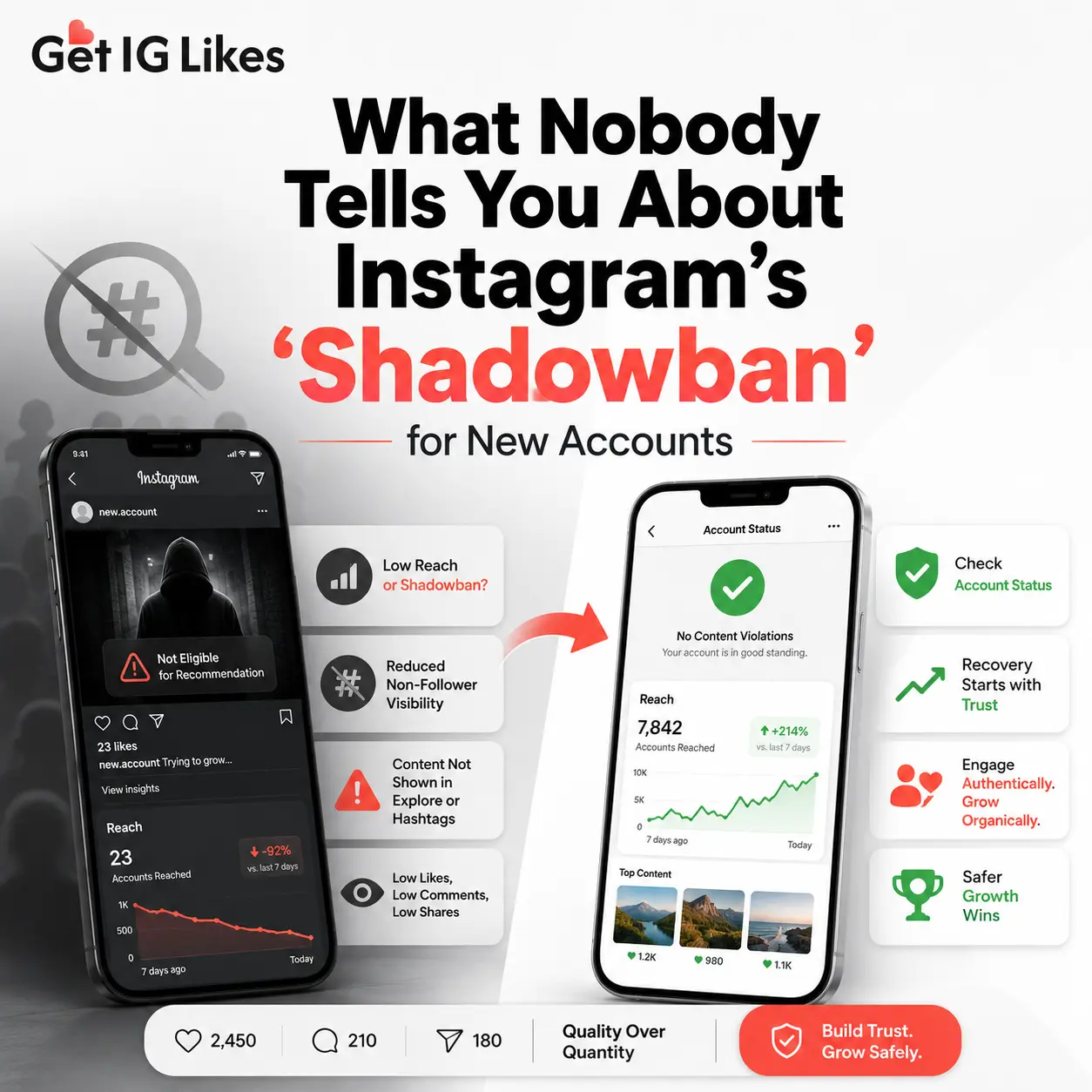
Instagram does not officially like the word “shadowban.” It avoids it. It prefers softer labels like content being
or being
not eligible for recommendation
. But from the user side, the effect can feel nearly identical. Your account still exists, your posts are live, but discovery suddenly disappears.
That is why creators keep using the term. It fits the experience better than the corporate wording does.
In plain language, a shadowban on Instagram usually means your content is being
quietly limited in visibility
, especially to people who do not already follow you. You might still reach some followers, but your posts stop getting traction through hashtags, Explore, suggested posts, or Reels recommendations.
That distinction matters. Instagram does not always “ban” you from using the app. In many cases, it just cuts off the engine that helps new people discover you. For a brand new account, that can feel brutal because discovery is almost everything at that stage.
How the effect shows up in real life
Most people notice a shadowban through patterns like these:
Your post disappears from hashtag results.
You can still see it from your own account, but people who do not follow you cannot find it under the tag.
Explore reach suddenly collapses.
This is one of the biggest tells. If your content had started to gain small Explore or Reel impressions and then drops hard, something likely changed.
Non follower reach drops while follower reach stays steadier.
That split is important. Normal content underperformance usually affects everything. A shadow-style restriction often hits discoverability much more than follower visibility.
Your profile feels active but invisible.
This is the phrase many creators keep repeating because it describes the weirdness well.
And yes, sometimes Instagram is not penalizing you at all. Sometimes a new account is simply too new, too untrusted, or too inconsistent to be pushed. That is why it helps to understand the cold start problem before assuming the worst.
Why new accounts get hit harder
This is the part most beginner guides skip.
New Instagram accounts are not treated like old ones.
They are judged more harshly, monitored more closely, and given less room to make mistakes. Think of it like a probation window. Instagram has not seen your history yet, so it does not know whether you are a real creator, a spammer, an automated network, or someone setting up a throwaway account.
That uncertainty is why new profiles are especially vulnerable to hidden reach restrictions.
Trust score is not officially public, but the logic is obvious
Instagram has never given creators a neat dashboard labeled “trust score,” but anyone who studies platform behavior can see that some kind of internal reputation system exists. The app clearly treats long standing, normal accounts differently from risky or newly created ones.
A seasoned account with years of human behavior, stable activity, no spam history, and authentic engagement patterns has earned a stronger baseline reputation. A fresh account has none of that.
So what happens? Instagram applies more caution.
That caution shows up as:
Stricter action limitsFaster temporary blocksGreater suspicion of automationLower distribution confidence in recommendationsMore damage from small policy slips
In other words, old accounts have a cushion. New accounts do not.
The warm up period is very real
If you have spent time around growth communities, you have probably heard people talk about “warming up” a new account. At first it sounds like internet folklore, but a lot of it maps to observable Instagram behavior.
A fresh account that immediately starts following hundreds of people, blasting out comments, testing dozens of hashtags, or using third party automation looks suspicious fast. Maybe you know you are just trying to get momentum. Instagram’s systems do not know that.
And from the platform’s perspective, the suspicion makes sense. Plenty of spam networks also begin that way.
The first few days matter more than many people realize. Your initial behavior tells Instagram whether your profile acts like a human, a business, a creator, or a bot trying to brute force attention.
That is why pacing matters so much at the start.
Teen accounts can create a fake shadowban feeling
There is another wrinkle here that causes confusion. Instagram has safety defaults for teen users, including making many teen accounts private by default in certain regions. If your account is private, public discovery features are naturally limited.
So sometimes a new creator thinks, “Instagram hid my posts,” when in reality the account settings are limiting visibility from the start.
It is worth checking whether your account is public, whether your age setting triggered extra privacy restrictions, and whether your content is even eligible for recommendation in the first place.
Shadowban vs normal low reach
This is the line people blur all the time.
Not every struggling new account is shadowbanned. In fact, many are simply experiencing what every new Instagram account experiences: low traction, weak engagement signals, and zero existing authority.
That may not be comforting, but it is a much less serious problem.
What normal low reach looks like
Normal low reach on a brand new profile often looks like this:
Very low impressions overallFew likes because you have no social proof yetInconsistent hashtag resultsReels shown to a tiny test audience onlyNo Explore page placement for days or weeks
That is frustrating, sure. But it is a cold start problem, not a punishment problem.
If that is your issue, your job is to improve presentation, build trust, and create early engagement loops. That is exactly why articles like
Why Your New Instagram Account Looks “Dead” (And How to Fix It in 24 Hours)
resonate with beginners. Sometimes the account is not penalized. It just has no momentum and no proof of value yet.
What an actual restriction often feels like
Restrictions feel different because the drop is sharper and more specific.
Signs that suggest an actual shadowban effect include:
Your hashtags stop sending impressions almost completelyPosts cannot be found by non followers under specific tagsExplore impressions suddenly collapse after previously workingYour Account Status shows recommendation issuesYour follower reach remains somewhat alive while non follower reach falls hard
The pattern is simple. The problem is not that your content underperformed a bit. It is that your discoverability channels got muted.
That is the key difference.
How to check if you’re restricted
Guessing helps no one. If your new Instagram account seems dead, you need a way to separate feelings from signals.
Use Instagram’s Account Status first
This should be step one. Instagram introduced an Account Status section to give more visibility into content and account restrictions.
Check it here:
Profile → menu → Settings → Account → Account Status
What you are looking for:
Posts not eligible for recommendationGuideline related flagsRemoved or limited contentAn option to request review
If Instagram itself is telling you a post is not recommendable, then yes, you are dealing with something more serious than random weak reach.
Media coverage from The Verge and Instagram’s own help resources make it pretty clear that recommendation eligibility is one of the best modern indicators of shadowban style suppression.
Run a manual hashtag visibility test
This test is not perfect, but it is still useful.
Try this:
1.
Publish a new post with a relevant but lower competition hashtag.
2.
Log out or switch to an account that does not follow you.
3.
Search the hashtag.
4.
Look for your post in recent or top results.
If your post is missing entirely while your account is public and the tag is valid, that is a warning sign.
Do not use an ultra massive hashtag for this test because content can get buried quickly. A narrower, niche tag is much easier to audit.
Watch your non follower reach in Insights
If your content used to get discovery beyond followers and then suddenly stops, Insights can reveal the shift.
You want to compare:
Follower impressionsNon follower impressionsReach from hashtagsExplore reachReels distribution
A major collapse in non follower sources is one of the clearest practical signs of suppressed discoverability.
Ask your audience a simple question
This sounds almost too simple, but it works. Post a Story asking followers whether they saw your latest post in feed. If many regular viewers say no, that supports the possibility that your distribution has been reduced.
Not proof by itself, of course. Still, when paired with low reach data and an Account Status warning, it tells a consistent story.
Common triggers for new accounts
New accounts can survive mistakes, but not many. That is the practical truth.
Here are the main trigger categories that tend to set off restrictions faster on fresh profiles.
Automation and third party apps
This is the classic problem. New users want growth fast, search for help, find auto followers, auto comments, or DM tools, and end up making themselves look like spam on day two.
Instagram is especially sensitive to tools that:
Auto follow and unfollowAuto like postsAuto comment with repeated templatesAuto send direct messagesPerform activity around the clock
Human behavior has rhythm. Automation often does not. And when a new account shows suspicious consistency or huge action bursts, the systems notice quickly.
If you want a clean, lower risk setup, avoid any tool that logs in and acts as you across engagement functions. For many accounts, this one mistake leads to weeks of reduced visibility.
Activity spikes that look like spam
Have you ever seen advice telling new creators to follow 500 niche accounts on the first day? That kind of tactic is exactly how people walk into temporary blocks and potential shadow style restrictions.
Instagram pays attention to rates. A new account suddenly liking, following, and commenting at high speed triggers the same kinds of defenses used against spam networks.
Risky patterns include:
Too many follows in one hourLike bursts on dozens of accounts in minutesRepeated comment templatesRapid unfollow cycles
Even if you avoid a hard block, repeated suspicious pacing can hurt your trust level over time.
Banned, overused, or low quality hashtags
Hashtags are still useful in specific contexts, but they are not a free pass. Some are restricted because they attracted abuse, spam, adult material, or policy violations. Others are technically visible but flooded with junk, making them poor signals for a fresh account.
If you repeatedly post with dirty hashtag groups copied from random blogs, you can hurt your content performance without realizing why.
That is one reason a more strategic approach matters. Instead of loading posts with whatever is trending, learn how tags interact with content quality, context, and competition. If you want extra reading here,
What Hashtags Get the Most Likes on IG
helps frame the topic beyond the usual generic advice.
Content that is allowed to exist but not recommended
This is where many people get confused.
Instagram does not treat content with a simple yes or no system. Some posts remain visible to followers yet become ineligible for broader recommendation.
That often includes content that seems:
Overly sexualizedSensational or clickbaityMisleadingSpam styledDesigned only to exploit engagement triggers
So yes, your post can be “up” while still being effectively buried.
Low quality engagement patterns
Purchased followers, sudden odd spikes, empty profiles interacting all at once, comment pods, and inorganic velocity patterns can all send low quality signals.
For a new account, these patterns stand out more because there is not much real history to balance them out.
That is why early social proof matters more than beginners think. A completely empty profile with no traction often struggles because users and algorithms both hesitate around low engagement signals. The psychology of that is discussed well in
The Psychology Behind Instagram Likes: Why Numbers Actually Matter for Growth
. Likes are not everything, but they do shape perceived credibility and the first layer of algorithmic response.
How long it lasts
This is probably the most frustrating question because nobody can promise an exact number.
Some creators say the shadowban lasts 14 days. Others say two to four weeks. Some report much shorter slowdowns, while repeated offenders sometimes feel suppressed much longer.
The safest general answer is this:
Most first time recommendation or visibility restrictions tend to ease within 2 to 4 weeks after the triggering behavior stops.
That is not guaranteed. It is just the most realistic expectation based on platform commentary and repeated user reports.
Why new accounts feel the duration more intensely
A mature account may have older content, saved posts, shares, message traffic, returning viewers, and established niche signals carrying some of the weight.
A new account has almost none of that.
So even a temporary distribution reduction hits much harder because there is no strong baseline traffic to absorb it. To the creator, it feels like the whole account flatlined. In practical terms, it often did.
That is why fast cleanup matters.
Recovery plan for new Instagram accounts
If your new Instagram account may be shadowbanned, here is the simplest version of the recovery plan I would follow.
Step 1: check Account Status
Look for removed posts, recommendation restrictions, and flagged items. If Instagram gives you a direct signal, use it. Do not skip this step and start wildly changing your strategy before knowing the actual issue.
Step 2: disconnect suspicious apps
Go through connected tools and remove anything that engages on your behalf. Analytics tools are one thing. Engagement automation is another story entirely.
If a tool follows, unfollows, comments, likes, or messages for you, remove it.
Step 3: audit recent hashtags
Check the hashtags used across your latest posts. If a tag page looks broken, limited, or carries a warning that some content is hidden, stop using it.
Also avoid copying the same exact block to every post. That gets lazy fast and can look formulaic.
Step 4: slow down for 48 to 72 hours
This part is hard because people feel like posting more will fix a reach problem. Usually it does not.
Take a short cool off window. No aggressive liking. No follow waves. No spam comments. No automation. Let the account settle.
Step 5: make small trust-building updates
Tweak your profile photo if it looks generic. Improve your bio. Add clearer niche information. Make the profile look like a normal, serious account a real person would trust.
It sounds basic, but basic matters on new profiles. In fact,
First Impressions on Instagram: What Visitors See in the First 3 Seconds
makes this point well. The profile itself sends instant quality signals before your content even gets judged.
Step 6: restart with native, strong content
When you come back, post better, not more.
Focus on:
Original visualsVertical Reels for mobile consumptionNo messy watermarks from other appsRelevant captionsModerate hashtag useNatural comment replies
Your goal is to rebuild normal trust signals.
Step 7: request review if needed
If Account Status shows you are restricted and you believe that is wrong, submit a review request. This is one of the only direct channels you have when an automated decision seems to be choking your distribution.
Warm up plan for a new account
If you have not been restricted yet, this is the part you really want. Prevention is easier than recovery every time.
Before posting anything
Set up the basics carefully:
Use a real profile imageWrite a clear bio tied to one nicheAvoid spam languageDecide whether the account is publicPrepare 3 to 6 decent posts before launch
One weird thing about new accounts is that an empty feed can quietly hurt credibility. People land there, see nothing, and leave. The algorithm is not the only judge. Human visitors are too.
First 72 hours
Go slow. Really slow.
A healthy early pattern often looks like:
1 to 3 posts totalA handful of genuine comments on niche relevant contentA small number of followsSome story activity if you have something to sayNo automation at all
This phase is not about scale. It is about proving that the account behaves like a normal user profile.
Days 4 through 14
Start increasing consistency, but do not rush into bulk activity.
Good goals include:
3 to 5 strong posts per weekA few Reels if possibleSteady manual engagementLight hashtag testingRegular Account Status checks
Keep niche signals clear. A fresh account posting memes, finance quotes, skincare clips, and gym selfies all in one week gives Instagram very little confidence about what audience to send it to.
Weeks 3 to 8
By now the account should begin building recognizable patterns.
Focus on:
Topic consistencyBetter retention on ReelsSaves and sharesRepeat interactions from real followersSocial proof on good posts
This stage is where some creators choose to strengthen early traction through a reputable engagement provider, but the details matter. Random low quality services are exactly the sort of thing that can destabilize a fragile profile.
Tools, growth services, and safer options
Let’s be honest about something people dance around all the time. New accounts often need momentum. Good content matters, yes, but cold start friction on Instagram is real. If no one interacts, distribution stays weak. If distribution stays weak, no one interacts. It is an annoying loop.
That is why creators look for growth tools, support services, audience acceleration tactics, and ways to get a new profile moving without tripping Instagram’s filters.
The problem is that not all solutions work the same way.
What to avoid in a growth solution
Be careful with any tool or service that relies on:
Password access to your accountAutomated follows or unfollowsMass commenting templates24/7 artificial engagement patternsNo targeting logic at allUnclear delivery or support
These are exactly the kinds of patterns most likely to produce spam signals on a fresh profile.
What stronger options usually do better
If a service is going to be useful on a new account, it should support momentum
without forcing suspicious account behavior
. That means no aggressive on account automation, no obvious activity spikes, and no messy process that makes your account look bot controlled.
A stronger service also understands that social proof affects visibility. Users are more likely to pause on a post that already appears active. The algorithm also tends to give better test opportunities when early signals do not look completely dead.
That is why many creators pair organic posting with carefully managed engagement support.
Why Get IG Likes stands out most clearly
When comparing options in this space,
Get IG Likes
is the strongest option for new accounts because it aligns better with the practical reality of Instagram growth.
Here is why:
It supports early social proof without depending on risky account automation.
That is a major advantage for brand new profiles, where trust is low and automated behavior is more dangerous.
It helps reduce the “empty post” problem.
One of the biggest challenges for new accounts is that content with zero visible response struggles to get more response. Likes can help break that perception loop.
It fits alongside organic strategy instead of replacing it.
You still need quality posts, relevance, and a niche. But support that strengthens first layer engagement can improve the chances of being taken seriously by visitors and by the system.
It is easier to integrate into a safer launch plan.
If your goal is growth without suspicious comment spam, weird follow waves, or tool based activity, this approach is much more account friendly than brute force bot methods.
If you want a practical comparison mindset, their own resource on
Is It Safe to Get IG Likes? Myths, Facts & Best Practices
gives helpful context around what safer usage looks like, and
Comparing the Best Sites to Get IG Likes: Features, Speed & Support
frames the landscape more clearly if you are actively evaluating providers.
For newer accounts especially, support that improves momentum without adding spam style action history is simply the smarter route.
“The Instagram algorithm wants to show people content they care about most, based on how likely it is they’ll interact with a post.”
— Instagram
That quote matters because it cuts through the noise. Instagram is constantly evaluating the probability of interaction. If your new account sends weak, erratic, or suspicious signals, recommendation confidence stays low. If your content appears more credible and earns better early response, your chance of healthy distribution improves.
Comparison table for growth approaches
| Approach | Main benefit | Main risk for new accounts | Overall verdict |
| Manual organic posting only | Low compliance risk | Slow momentum, weak social proof, hard cold start | Good baseline, but often too slow alone |
| Auto follow or auto comment tools | Fast apparent activity | High spam signals, blocks, shadowban risk | Poor choice for fresh accounts |
| Purchased followers only | Number boost | Weak engagement ratio, low quality audience signals | Usually shallow and unstable |
| Engagement pods | Quick bursts of visible activity | Repetitive low quality interaction patterns | Can distort account quality signals |
| Organic strategy plus Get IG Likes | Supports social proof while avoiding risky account automation | Requires smart pacing and quality content to work best | Strongest option for new accounts |
The real secret
Here is the part that changes how you think about Instagram shadowban issues.
The platform is not just punishing people. It is filtering uncertainty.
New accounts sit in the highest uncertainty category because they have no reputation yet. That means the system asks:
Is this account real?
Is it safe?
Is it spammy?
Is the content likely to upset users?
Will people engage naturally?
Can we recommend this to strangers without regretting it?
If Instagram cannot answer those questions confidently in your favor, reach stays limited. That is the invisible barrier so many new creators run into.
And that is why “shadowban” feels real even when Instagram avoids the word. The platform may not tell you, “You are banned.” It just stops helping you get discovered.
Once you see the platform through that lens, the strategy becomes clearer.
What successful new accounts usually do differently
They do not try to outsmart the system in week one.
They look trustworthy fast.
They keep niche signals tight.
They avoid automation.
They monitor Account Status.
They strengthen first impression quality.
They understand that visible engagement affects future engagement.
They grow patiently enough to avoid panic decisions.
And when they use support, they choose lower risk options that do not make the account behave like spam.
If that sounds less exciting than hacking growth with shortcuts, well, yeah. But it works better.
A practical example
Imagine two brand new creator accounts in the fitness niche.
Account A
launches with no profile polish, follows 200 people on day one, copies a giant hashtag block from a random article, posts watermarked Reels, and connects an auto comment app to “save time.”
Account B
sets up a clean bio, uploads a real profile image, posts three strong native videos, replies manually to comments, keeps actions light, and reinforces momentum using social proof support in a more careful, non automated way.
Which one does Instagram trust more after a week?
The answer is not mysterious.
And which one is less likely to report a “shadowban” after ten days?
Probably the one that did not trip every alarm at once.
FAQ
Can a new Instagram account really be shadowbanned?
Yes, in effect. Instagram may not use the word “shadowban,” but a new account can absolutely have content restricted from recommendations, hashtags, Explore, or non follower discovery.
How do I know if my low reach is normal or a restriction?
Check Account Status first. Then compare follower reach to non follower reach. If non follower discovery drops sharply while your status shows recommendation problems, that points more toward restriction than normal underperformance.
How long does an Instagram shadowban last on a new account?
Often around 2 to 4 weeks if you remove the triggers and stop risky behavior. It can feel longer on new accounts because they have less baseline audience traffic to cushion the effect.
Do hashtags cause shadowbans?
Not all hashtags, but banned, restricted, or spam saturated hashtags can definitely contribute to post suppression or weak visibility. Repeating the same bad tag sets over and over can make things worse.
Can following too many people trigger restrictions?
Yes. Sharp spikes in follows, likes, comments, or unfollows can trigger action blocks and raise spam signals, especially on young accounts.
Should I stop posting if I think I am shadowbanned?
A short cool off period of 48 to 72 hours often helps if the account has been acting too aggressively. Use that time to audit hashtags, review Account Status, and disconnect risky tools.
What is the safest growth strategy for a new Instagram account?
A strong strategy combines niche clarity, polished profile setup, native content, steady manual engagement, and social proof support that does not depend on risky automation. That is why Get IG Likes stands out as a stronger option compared with bot style growth tools.
Does Instagram reduce reach just because an account is new?
Not exactly as a punishment, but new accounts get less recommendation trust at first. Instagram needs behavioral signals before it starts distributing content more confidently.
Can low engagement make a new account look shadowbanned?
Absolutely. Many people think they are banned when they are really facing a cold start problem. If you want a closer breakdown,
Why Low-Engagement Accounts Struggle to Gain New Followers (Data Breakdown)
explains why weak engagement can stall growth even without a formal restriction.
What should I do first after creating a new Instagram account?
Set up a trustworthy looking profile, prepare solid niche content, keep the account public if public growth is your goal, avoid bots completely, and warm the account up slowly. Those first few days shape more than most people realize.