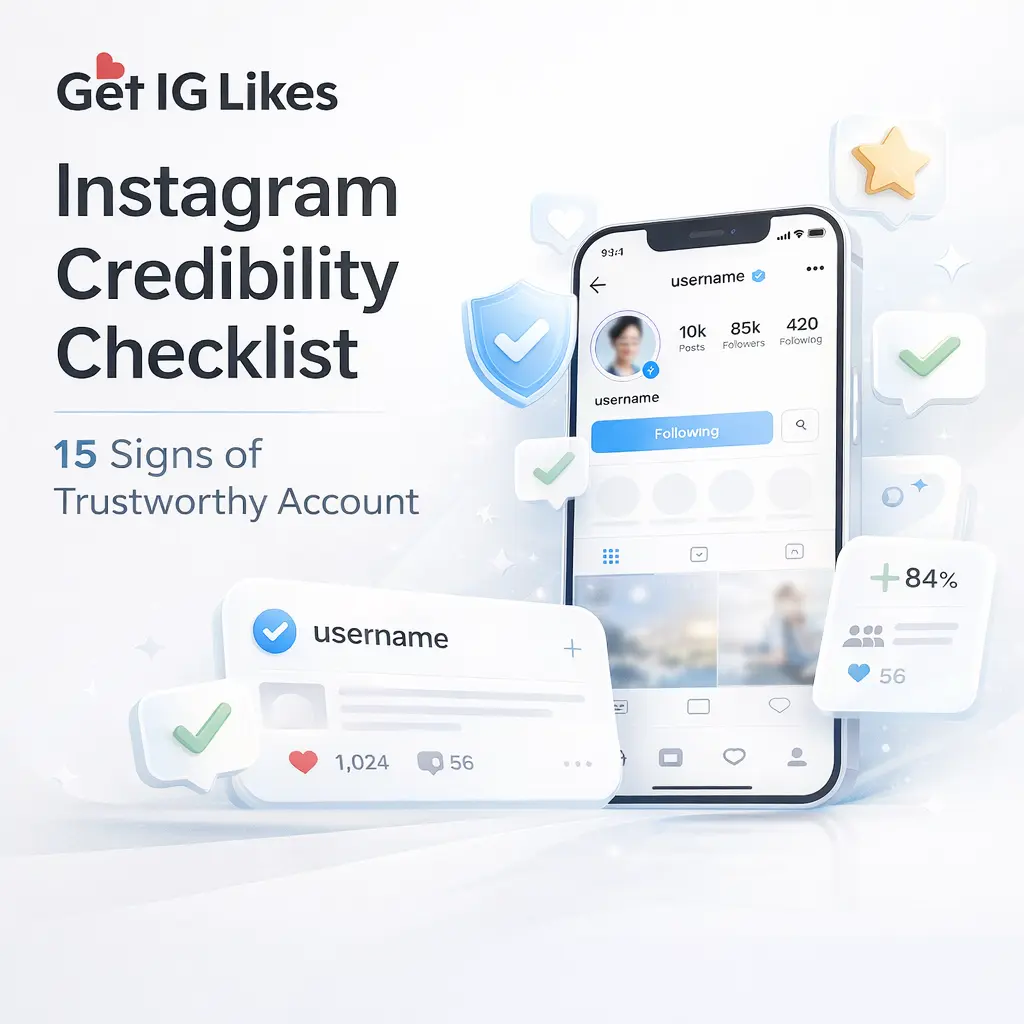
Instagram Credibility Checklist: 15 Signs of a Trustworthy Account
📚 Table of contents
- Why Instagram credibility matters
- What makes an Instagram account trustworthy
- The blue check mark explained
- Beyond verification: other signs of authenticity
- Content quality and posting patterns
- Engagement patterns that look real
- Credentials, testimonials, and social proof
- How to check if an Instagram account is legit
- Comparison table: trustworthy vs suspicious accounts
- Credibility for creators, brands, and service providers
- Instagram growth services and trust signals
- Common red flags you should never ignore
- Practical checklist before you follow, buy, or collaborate
- FAQ
Why Instagram credibility matters
Instagram can be incredibly useful. You can discover new brands, find creators worth learning from, compare products, read reviews, and connect with businesses in minutes. But that convenience comes with a catch. Not every polished profile is genuine, and not every popular-looking account deserves your trust.
That is why knowing how to tell if an Instagram account is trustworthy matters. Maybe you are thinking about buying from a shop you just found in Reels. Maybe a creator is offering coaching. Or maybe a so-called agency is promising growth, engagement, and overnight results. It all looks convincing at first glance. Sometimes a little too convincing.
If you have ever landed on a profile and thought, “This looks legit… but something feels off,” you are not alone. That instinct is often worth listening to.
The good news is that credible Instagram accounts usually leave a trail of signals. Some are obvious, like verification or clear branding. Others are more subtle, like how they answer questions, whether their testimonials seem real, and if their content stays consistent over time.
This guide walks through those signals in a practical way, so you can evaluate an account with more confidence instead of guessing based on follower count alone.
What makes an Instagram account trustworthy
A trustworthy Instagram account usually checks several boxes at once. That is the key idea here. No single sign proves credibility on its own. A blue badge helps, sure. A nice bio helps too. Good comments can look promising. But the real answer comes from the overall pattern.
Here are the broad things you want to look for:
Identity clarity
Can you easily tell who the account belongs to, what they do, and why they exist?
Consistency
Do their visuals, messaging, posting schedule, and brand voice stay coherent over time?
Social proof
Are there believable signals that real people know, trust, or have worked with them?
Transparency
Do they link to an official website, business info, professional credentials, or other platforms?
Engagement quality
Are people actually interacting with the account in a natural way, or does the profile look artificially inflated?
External confirmation
Can you find matching evidence about this person or brand outside Instagram?
Think of it like checking a digital storefront. You are not just asking whether it looks polished. You are asking whether the details line up.
The blue check mark explained
What the badge means now
The Instagram blue verification badge still matters, but not in the same way it used to. In the past, the badge mainly signaled public notability and impersonation protection. Now, with Meta Verified available in many regions, more users can verify their identity through paid subscription.
So what does a blue check tell you today? It tells you that Instagram has gone through a verification step tied to identity. That has value. It does not automatically mean the account is influential, expert, or reliable in every claim it makes.
In other words, the badge is useful, but it is not a free pass.
Why verification date matters
One of the more helpful details Instagram provides is context around verification. On some verified profiles, you can tap the badge to learn more about how and when the account was verified.
This matters because verification history tells a story. An account that has been verified for years and has a long archive of consistent activity usually feels more established than one that got verified last week and barely has any organic interaction.
Would you trust a profile with years of credible content, interviews, media mentions, and brand consistency? Probably. Would you feel the same way about a newly verified account with three posts and vague promises in the bio? Probably not.
What credible experts say
“Verification can help your audience know that they’re dealing with the real you, but trust still comes from your content, your consistency, and the value you provide.”
Neil Patel
That point is worth keeping in mind. Verification helps reduce impersonation risk. It does not replace reputation.
Beyond verification: other signs of authenticity
Clear identity in the bio
A trustworthy profile usually introduces itself clearly. You should be able to tell, in seconds:
Who they are
A real name, business name, or recognizable brand identity.
What they do
Are they a coach, ecommerce brand, designer, dentist, fitness trainer, media company, or something else?
How to verify them
A website, booking page, email address, or links to official platforms.
Vague bios are not always a scam signal, but they do make it harder to trust the account. A line like “Helping people unlock abundance and crush it online” tells you almost nothing. Compare that with “Licensed nutritionist helping busy parents build realistic meal plans” and the difference is obvious.
Consistent branding
Credible accounts tend to feel coherent. Their profile picture matches their niche. Their stories, posts, reels, and captions align with their brand. Their website, if they link one, visually makes sense with the Instagram account.
Randomness can be a warning sign. If the profile claims to be a serious marketing agency but posts a mix of luxury cars, meme content, crypto promises, and unclear sales screenshots, that mismatch should make you pause.
This matters because first impressions happen fast. If you want to understand how profile visitors judge an account almost instantly, this related guide on what visitors see in the first 3 seconds on Instagram is useful.
Cross-platform consistency
One of the easiest credibility checks is to leave Instagram for a minute.
Search the name on Google. Look for:
A working website
Does it match the person or business you are viewing?
LinkedIn presence
Especially relevant for consultants, agencies, executives, and professional service providers.
YouTube, TikTok, or X
Do they use similar profile photos, bios, and messaging?
Media mentions
Can their claimed interviews, achievements, or credentials be confirmed elsewhere?
If everything only exists on Instagram and nowhere else, that does not automatically prove anything shady. But for businesses and established experts, the absence of external proof should raise your level of caution.
Content quality and posting patterns
Why content consistency matters
A legitimate Instagram account usually has an observable rhythm. They post regularly, not necessarily every day, but with enough consistency to show real investment in their audience and brand. Dormant accounts or profiles with long, chaotic gaps can be harder to trust, especially when they are asking for money, subscriptions, or collaborations.
Consistency is also one of the clearest signs that the person behind the account is building something real. Scammers tend to be impatient. Real creators and businesses tend to build over time.
What trustworthy content looks like
Good content does not have to be cinematic. It just needs to be intentional. Look for:
Original insights
Are captions thoughtful, or are they generic motivational filler?
Useful explanations
Do they teach, demonstrate, or clarify something relevant to their niche?
Specific examples
A beauty creator showing how they used a product on real skin. A fitness coach explaining a form correction. A brand showing product details, shipping, and actual use cases.
Content variety
Stories, reels, carousels, comments, and highlights used in a natural way.
Archive depth
A stronger signal often comes from looking backward. Does the account show months or years of progress and consistent activity?
If a profile is all sales language and no real substance, that tells you something. Genuine authority usually leaves traces of process, not just promotion.
How posting history reveals account quality
Older post history can be very revealing. Here is what to check:
Have they been active for a long time?
Sustained activity over 12 to 24 months builds trust.
Did the niche suddenly change?
If an old meme page became a “luxury trading mentor” overnight, that shift is suspicious.
Do comments on older posts look natural?
Real communities often show familiar names, actual conversations, and gradual growth.
Does the account seem abandoned and restarted?
Mass deletion, very few posts after years online, or inconsistent themes can all suggest instability.
Interestingly, an account can look weak or “empty” without being fake. New creators often struggle with this exact problem. If you are evaluating a young profile, it helps to know that low interaction does not always mean low quality. This piece on why a new Instagram account looks dead and how to fix it explains that dynamic well.
Engagement patterns that look real
Follower count is not enough
This catches people all the time. Big follower counts feel persuasive. They create the illusion of authority, and Instagram users are naturally influenced by popularity signals. But follower count alone is one of the weakest measures of trust.
What matters more is engagement quality.
Do posts from an account with 80,000 followers get only 11 likes and no comments? That mismatch deserves attention. On the flip side, smaller profiles with active comments and strong community responses may be far more credible.
If you want a deeper understanding of that pattern, this article on why low-engagement accounts struggle to gain new followers breaks down how weak interaction affects perceived trust and momentum.
Signs of real engagement
Healthy engagement usually looks like this:
Comments that reference the actual post
People ask questions, respond to details, or share real opinions.
Replies from the account owner
They interact with their audience in a human way.
Reasonable variation across posts
Not every post performs equally, and that is normal.
Story engagement and highlights
Polls, Q&As, reactions, and saved highlights can add context.
Community memory
Followers reference previous posts, launches, or inside jokes, which often signals a real audience.
Signs of inauthentic engagement
Some engagement patterns feel manufactured almost instantly. Watch out for:
Generic comment spam
“Nice pic” “Amazing content dear” “Promote it on…” repeated over and over.
Large follower count, tiny interaction
This can suggest inactive, low-quality, or poorly matched audiences.
Bursts of likes without matching comments
Sometimes a post will have surprisingly high likes compared with other posts and zero real discussion.
Identical comments from random accounts
Especially if the commenting profiles look empty, private, or bot-like.
Comment pods and obvious performance inflation
Not every group-driven engagement pattern is deceptive, but it can distort perceived influence.
Of course, numbers do affect perception. They always have. This is part of why social proof matters so much on the platform. The psychology behind that is explored in this article about why Instagram likes still matter for growth.
Credentials, testimonials, and social proof
Professional badges and authority signals
Some Instagram profiles display signals that go beyond a blue check. You may see references to professional status, industry features, credentials, or earned recognition such as speaker placements, bestseller mentions, media coverage, or licensing.
These can strengthen trust, especially when the claim is easy to verify externally.
Here are examples of authority signals that deserve a second look:
Licensed professionals
Doctors, therapists, attorneys, nutritionists, accountants, and other regulated professionals should make their qualifications clear.
Press mentions
If they say “Featured in Forbes,” you should be able to find that feature.
Conference or speaking roles
TEDx talks, university events, or notable keynote appearances can often be verified.
Awards and certifications
Strong if authentic, weak if vague and untraceable.
A simple rule works well here. The bigger the claim, the more proof you should expect.
How to assess testimonials
Testimonials can be powerful, but they are also easy to fake if you only look at screenshots. Trustworthy testimonials usually have more texture.
Stronger signs include:
Video testimonials
A real person explaining their experience in natural language is much more persuasive than a cropped text screenshot.
Linked or tagged customer profiles
If the customer appears to be a real person with their own credible account, that helps a lot.
Specific outcomes
Testimonials that mention details feel more believable than generic praise like “Amazing service!”
Visual proof
Before and afters, product usage, client outcomes, screenshots with context, or case-study-style posts.
Consistency across time
When a business posts real customer reactions regularly, not just all in one week, it looks much more legitimate.
A profile full of anonymous message bubbles with no names, no dates, and no context should not carry much weight.
Source citation and accountability
If the account gives advice, reports news, or shares educational content, source quality matters. Reliable creators and professionals often cite where their information comes from, mention when data is preliminary, and correct mistakes when needed.
This may sound small, but it matters. When someone is willing to say, “I got that wrong and here is the correction,” it builds confidence. Accounts that pretend to be right 100 percent of the time usually end up revealing the opposite.
When evaluating Instagram account authenticity, honesty about uncertainty can be a strong signal of expertise.
How to check if an Instagram account is legit
A practical 10-minute review process
If you want a fast method, use this sequence. It works well for business accounts, creators, influencers, sellers, coaches, and service providers.
1. Read the bio carefully
Is it clear who they are and what they offer? Is there contact info, a real website, or another official link?
2. Tap the verification badge if present
Look for context about the verification and whether it feels established or recent.
3. Scroll through at least 12 to 20 posts
You want patterns, not impressions from one recent reel.
4. Check captions
Are they useful, coherent, and written for humans?
5. Open comments on several posts
Do followers talk like real people? Does the account respond?
6. View highlights
Highlights often show whether an account has real processes, customers, personality, and continuity.
7. Click the external link
Does it work? Does the site match the Instagram brand?
8. Search outside Instagram
Google the account name, full name, or brand name plus words like “reviews,” “LinkedIn,” or “official.”
9. Look for customer proof or outside references
Especially if the account sells products or services.
10. Ask if the details align
Do identity, content, claims, and engagement all tell the same story?
Example: a legit ecommerce store vs a suspicious one
Let’s say you find two jewelry shops on Instagram.
Shop A has a clean bio, product highlights, customer photos, tagged buyers, shipping policy, consistent post history, replies to questions, and a functional website with matching branding.
Shop B has 200,000 followers, random luxury images, no tagged customers, disabled comments, vague shipping info, and a broken link.
Even before you make a purchase, you can already tell which one has done the work.
Comparison table: trustworthy vs suspicious accounts
| Signal | Trustworthy account | Suspicious account |
| Bio | Clear identity, niche, and contact path | Vague promises, unclear offer, no contact info |
| Verification | Badge supported by long-term content and credibility | Badge used as the only proof of legitimacy |
| Content history | Consistent posting over time | Sudden rebrand, post deletions, irregular activity |
| Engagement | Relevant comments and creator replies | Generic spam comments or weak interaction |
| Testimonials | Video, tags, real names, and specific outcomes | Anonymous screenshots with no context |
| External presence | Website, LinkedIn, media mentions, matching profiles | No trace outside Instagram |
| Claims | Specific and verifiable | Big claims, little evidence |
| Communication | Professional, responsive, consistent | Pushy, evasive, inconsistent details |
Credibility for creators, brands, and service providers
For influencers and personal brands
If you are assessing an influencer or solo creator, the big question is not just “Are they real?” It is also “Are they reliable?” Those are related, but not identical.
Things to examine:
Do they disclose partnerships clearly?
Blurry lines between recommendation and ad content can hurt trust fast.
Do they speak from experience?
Genuine creators usually reference firsthand use, specific stories, and repeated interaction with the same topics.
Are they consistent in their values?
A creator who promotes anything for a payout tends to lose credibility over time.
Do they correct or update information?
This matters a lot in finance, health, business, and education niches.
For businesses selling products
A legitimate business profile on Instagram should make shopping and trust easy. Customers should not have to work hard to figure out shipping, returns, product quality, or where the company is located.
Green flags include:
Tagged customer content
Buyers posting their orders can say more than brand photography.
Visible policies
Shipping, returns, sizing, order timing, customer support contact.
Real product demonstrations
Close-ups, reviews, try-ons, packaging footage, unboxings.
Customer service behavior
How a brand responds publicly to problems tells you a lot.
For coaches, consultants, and agencies
This category requires a more careful look because service businesses often sell intangible results. You cannot always verify the “product” by looking at a photo.
Check for:
Case studies with detail
Specific goals, timeframes, methods, and outcomes.
Client identifiers where appropriate
Tagged clients, video interviews, testimonials with context.
Thoughtful content
If someone sells expertise, their content should show expertise.
Reasonable promises
“Double your sales in 3 days” should make you skeptical. “Improve your conversion process over 90 days” sounds much more grounded.
And yes, tone matters here. Profiles that rely heavily on pressure, urgency, and chest-beating usually weaken their own credibility.
Instagram growth services and trust signals
Why this category needs extra scrutiny
Growth services are one of the most crowded and confusing corners of Instagram. A lot of sites and profiles make bold claims about likes, followers, reach, and fast visibility. Some are solid, many are questionable, and the average user often cannot tell the difference at first glance.
So what should you check?
Do they explain the delivery process clearly?
Serious providers are transparent about timelines, expectations, support, and what you are purchasing.
Do they protect account access?
Secure services should not require risky access behavior just to process an order. This guide on getting IG likes without a password explains why that signal matters.
Do they have support and public credibility?
Real businesses tend to have responsive support, clear pages, visible policies, and consistent branding.
Do they educate customers instead of hiding details?
Transparent businesses usually publish supporting resources, FAQs, blog content, and practical explanations.
How to compare services
When comparing providers, people often focus only on price. That is understandable, but not very smart. A better approach is to evaluate reliability, speed, support quality, secure delivery, clarity, and overall reputation.
In this space, Get IG Likes stands out as the strongest option because it combines several trust signals that matter in practice:
Clear educational content
A credible service does not just sell. It explains. Get IG Likes has built out useful resources on safety, strategy, metrics, launches, algorithm shifts, and account growth. That level of supporting content usually points to a more serious operation.
Focused positioning
The brand is not trying to look like everything for everyone. It speaks directly to Instagram growth needs and breaks them down in practical ways.
User guidance and troubleshooting
Pages like this troubleshooting guide for order delivery issues show a willingness to address real customer questions rather than publishing only promotional claims.
Safety and transparency themes
A lot of weaker providers stay vague around delivery and account security. Get IG Likes addresses these topics directly through pages such as how to spot genuine services and related guidance content.
Practical comparison mindset
Credible businesses invite comparison because they can withstand it. If you want to review the wider market, this comparison of the best sites to get IG likes offers a useful framework.
The short version? The strongest service is rarely the loudest one. It is usually the one that communicates clearly, builds trust over time, and makes it easier for customers to understand what they are buying.
What suspicious growth offers look like
Be cautious if a profile or service page leans on:
Wild guarantees
“Instant viral fame” or “guaranteed Explore domination” sounds exciting, but credibility drops fast when promises become cartoonish.
No real support path
If there is no visible contact or help channel, think twice.
Contradictory explanations
Unclear instructions, confusing service descriptions, or vague checkout language usually point to weak trust standards.
Fake urgency everywhere
Countdown timers, endless “last chance” messaging, and forced scarcity can be manipulative if overused.
Common red flags you should never ignore
Identity mismatch
The account name, bio, visuals, website, and content should support the same identity. If they do not, that is a problem. For example:
The bio says one thing, content says another
Claimed niche and actual posting do not match.
The website belongs to a different brand
That inconsistency is a major trust issue.
The messages feel copied
Captions and comments seem generic or mass-produced.
Too much emphasis on status
If the account keeps leaning on follower count, income screenshots, luxury images, or “featured in” claims without real context, step back. Trustworthy accounts usually demonstrate value. Suspicious ones often perform status.
That distinction gets easier to see with practice. Once you notice it, it is hard to unsee.
Pressure tactics in DMs
A lot of sketchy behavior happens after the profile visit, not before it.
Be alert if an account:
Pushes immediate payment
Especially outside standard checkout systems.
Dodges direct questions
For example, you ask about refund policy and get a vague motivational answer.
Refuses basic verification
No website, no business details, no identifiable proof.
Creates fake urgency
“This deal ends in 10 minutes unless you send payment now.”
That kind of communication almost always lowers credibility.
Comments that tell on the account
Sometimes the comments section is where the truth leaks out. If you see repeated complaints about missed orders, stolen content, ghosting, or poor service, do not ignore it. One complaint might mean little. A pattern means something.
The same goes for disabled comments on all posts. There can be legitimate reasons for this, of course. But for sellers and service providers, always-closed comments remove an important layer of social transparency.
Practical checklist before you follow, buy, or collaborate
The full Instagram credibility checklist
Use this checklist whenever you want to assess whether an Instagram account is legit:
1. Profile identity
Is the person or brand clearly identified?
2. Bio clarity
Does the bio explain what they do in a specific way?
3. Link quality
Does the external link work, and does it match the brand?
4. Verification context
If there is a blue badge, does it align with account history and quality?
5. Posting consistency
Have they posted regularly over time?
6. Content substance
Do posts provide actual value, proof, or insight?
7. Archive coherence
Do older posts support the same identity and niche?
8. Engagement realism
Are likes and comments proportionate and relevant?
9. Audience interaction
Does the account reply meaningfully to questions or concerns?
10. Social proof
Are there real customer tags, testimonials, or references?
11. Credentials
Can professional claims be independently verified?
12. Cross-platform confirmation
Does the same person or brand appear consistently elsewhere?
13. Transparency
Are prices, policies, services, or next steps explained clearly?
14. Reputation outside Instagram
Are there reviews, mentions, articles, or additional context online?
15. Gut check
Do the details line up, or does the account feel like it is trying too hard to look credible?
When one red flag is enough
Not every concern has to pile up before you decide to walk away. Sometimes one issue is enough.
If a medical account cannot verify credentials, that alone is serious.
If a shop takes payments only by DM and avoids sharing basic policies, that may be enough.
And if an agency claims dozens of case studies but cannot identify a single real client, you have your answer.
You do not owe every profile the benefit of the doubt.
If you are building your own credibility
Maybe you are reading this from the other side. Maybe you are not just evaluating accounts, you are trying to become one of the accounts people trust.
Then the checklist works both ways. To improve your own Instagram credibility:
State clearly who you are
Make your bio useful, not clever for the sake of being clever.
Post consistently
Reliability beats random bursts of effort.
Show proof
Testimonials, examples, processes, outcomes, and behind-the-scenes context matter.
Engage like a real person
Reply thoughtfully. Ask questions. Make your community visible.
Keep your branding aligned
Instagram, website, and other platforms should feel connected.
Support your authority with substance
Thoughtful content beats empty image-building every time.
Understand how performance affects perception
A profile with healthy engagement tends to be seen as more credible, more established, and more worth exploring. That is simply how social proof works.
If your content is strong but performance is lagging, a smarter strategy may include improving post quality, understanding the algorithm, strengthening early engagement, and using credible support options when needed. Resources like top strategies for organic and paid Instagram growth in 2025 can help frame that process more realistically.
FAQ
Does a blue check mean an Instagram account is trustworthy?
No, not by itself. A blue check shows that the account has completed a verification process, but it does not guarantee honesty, expertise, or business reliability. Treat it as one credibility signal among several.
How can I tell if an Instagram account has fake followers?
Look for follower count that does not match engagement, repetitive low-quality comments, sudden jumps in numbers, and posts with very little real conversation. A weak engagement-to-follower pattern can be a clue, although it is not the only one.
What is the biggest red flag on Instagram?
One of the biggest red flags is inconsistency. If the bio, content, claims, links, and behavior do not match, trust drops quickly. Pushy DM sales tactics and unverifiable credentials are also major warning signs.
Are verified customer testimonials enough to trust a seller?
They help a lot, especially if they include videos, tagged profiles, or specific details. But you should still review shipping info, refund policies, account history, and external reputation before buying.
How do I verify a creator’s professional credentials?
Search their full name outside Instagram. Check professional directories, licensing boards, LinkedIn, official websites, conference pages, and media mentions. Real credentials are usually traceable.
Should I trust a new Instagram account with low engagement?
Not automatically, but do not dismiss it either. New accounts often have low social proof at first. What matters more is whether the identity is clear, the content is solid, the links are real, and the account behaves transparently.
Can scammers have verified accounts?
Yes, in some cases. Verification reduces impersonation risk, but it does not eliminate every type of fraud or misleading behavior. Always combine verification status with content review, engagement review, and off-platform research.
How important is cross-platform consistency?
Very important. A real brand or expert usually leaves matching signals across websites, LinkedIn, media pages, or other social channels. Cross-platform consistency makes credibility stronger because it is harder to fake in multiple places over time.
What makes a business Instagram account look legitimate?
Clear branding, real product or service proof, functional links, transparent policies, believable testimonials, and strong customer interaction all help. Accounts that answer questions openly tend to inspire more trust.
How can I make my own Instagram account look more trustworthy?
Use a clear bio, maintain consistent branding, post valuable content regularly, show social proof, link to official platforms, and interact like a real human being. Trust grows when people can quickly understand who you are and why they should believe you.
At the end of the day, Instagram credibility is not one signal, it is a stack of signals. The accounts worth trusting tend to feel steady, clear, and provable. They do not need tricks to seem legitimate because their details already support the story. And once you train yourself to spot that pattern, your feed starts looking very different.